Writing Portfolio

16.9.14

St Lawrence Market

We’re in Toronto, and on our first morning we went to the centre of town to visit the St Lawrence Market. This old-fashioned covered market and local landmark is not only a mecca for food-lovers of Toronto but has been hailed by National Geographic as the top food market in the world. Not in North America. The world. (Borough Market, by the way, came tenth.)

Located in the part of town known as Old York (York having been the name of the settlement established here by Governor Simcoe in the 1790s; it was renamed Toronto in 1834), the market has been running for over 200 years.

The items on offer on the lower level are a fair reflection of modern Toronto’s diversity; as well as coffee from just about anywhere in the world (they’ll even grind it for you should you so wish) and many varieties of rice, you can get perogies, crêpes, souvlaki, spices, meat pies, Chinese food, more preserves than you’d care to name and all sorts of other tasty treats here. Up on the main level butchers, bakers, fishmongers and cheesemongers (who do a good line in cheeses imported from places like England, France and Italy as well as Canadian cheeses) co-exist side by side in St Lawrence, where the only problems appear to be people who suddenly stop to look at things, as well as the perennial dilemma of what to buy, and who to buy it from.


We found a wine merchant who seemed very happy to talk about the various Ontario wines he had on offer; a few samples later and we were walking away with a bottle of ’13 Riesling (Ontario Riesling being somewhat less sickly-sweet than its German counterpart) and a ’12 Trius Red (a blend of Cab Sauv, Cab Franc and Merlot; it’s superb, and surprisingly mature-tasting for a two year-old wine).


For lunch, the crowds seem to know that the Carousel Bakery is the stall to head to; this is the one that is best-known for serving up the Torontonian take on the bacon roll that is the peameal bacon bun (“Experience this Toronto tradition, eh!”). Cut much thicker than a regular rasher of bacon, peameal bacon is made from boneless pork loins rolled in ground yellow cornmeal (originally, ground yellow peas were used, hence the name), and it is a Toronto speciality which harks back to the time when the city was nicknamed ‘Hogtown’ due to the large number of pork processing facilities that existed here in the late nineteenth and early twentieth centuries.  It’s delicious and filling, but don’t just take my word for it; when Anthony Bourdain came here for The Layover, it’s what he had for breakfast.


The wares on the various seafood stalls looked fantastic –live lobsters, sushi-quality tuna steaks, wild salmon from British Columbia, scallops, oysters … we went for the mussels (from Prince Edward Island) which were on display in a large tank of water, from which our order was scooped out.


The butchers are masters of their trade who are happy to guide customers in the ways of all the different cuts and varieties that can be had. Should you want some mustard to go with your newly-purchased meat, there’s a stall for that where you can sample dozens of different types; I even found a couple that I rather liked (and I speak as someone who, as a rule, doesn’t particularly like mustard).


Elsewhere, two fruit-and-veg stalls compete for trade side by side, under a sign reminding customers that “We’re two separate stores”. One can only imagine the arguments that occurred before that went up! We purchased a few items from one of these places which, later that day, joined the mussels in a delicious moules marinieres.

St Lawrence Market: Gourmet’s paradise. A Toronto must-visit.

6.9.14

Meatopia 2

Meatopia returned to the Docklands this weekend, and having been impressed with it last year, we returned to Meatopia, the carnivorous foodie festival where everything is cooked over wood or charcoal.

 View IMG-20140906-00381.jpg in slide show

On entering a Tobacco Dock that was decidedly less smoky than last year (those issues having evidently been sorted out second time around), we were greeted by no less a person than the founder of Meatopia, Josh Ozersky. I’m impressed by the fact that with all that must be going on at a big event such as this, he found the time to mingle with the punters.

 View Tower Hamlets-20140906-00392.jpg in slide show

View Tower Hamlets-20140906-00388.jpg in slide show

We had, of course, come for the meat and we were not disappointed. We got to try Charcoal grilled Flat Iron Steak with anchovy butter (courtesy of the ever-excellent Hawksmoor), Tasty Pig & Beef Bits Taco (The Greenhouse Tavern of Cleveland, Ohio), Korean BBQ Pork Belly (Judy Joo of New York), Meatopia Double Smoked Cheddar Dog (Shake Shack; I really need to go to their place on Covent Garden) and the Burger with comte cheese, pulled Beef Ribs, Baconnaise – a real thing, it seems – & smoked chillis (Tommi’s Burgers). All were superb, and as an added bonus we did not get caught up in any two-hour queues this time.


According to Christian Stevenson (a.k.a. DJ BBQ), the master of ceremonies at the demonstration area that is the Cutting Room, the organisers had far more chefs, restaurants etc interested in cooking than there were spaces (this despite the event being spread out over two days), so they were having to turn would-be barbecue-ers away.

Liquid refreshment came courtesy of Fuller’s, which has recently created a craft lager called Frontier. This is not something that has come up on my beer radar, despite the fact that I have been known to frequent Fuller’s pubs (although the fact that I usually go for bitter may well have played a part in my not noticing that they’ve branched out into lager); hand-crafted over 42 days, it’s a good refreshing pint.

We got to see an entire cow being spit-roasted, presumably for the benefit of those who will be attending tomorrow.  

 View Tower Hamlets-20140906-00382.jpg in slide show

Music was provided by a seven-piece band called the New York Brass Band who played instrumental versions of 1980s hits. The tuba-player, who appeared to be the one in charge, did not sound American when he announced his band, but he got a laugh by saying that they are in fact from York. 

As for demonstrations, we got to see two guys from a fun-sounding Sussex-based organisation called Hunter Gather Cook butcher a deer carcass on the stage, serving up some wild venison carpaccio in the process along with advice about how to go about hunting deer and butchering venison, the latter being possible to do in your back garden. Not that I’m getting any ideas, of course.

 View Tower Hamlets-20140906-00386.jpg in slide show

The highlight of the day was Dario Cecchini, the master butcher of Panzano who has cropped up on this blog before (if you’re going to go to Tuscany, I highly recommend eating at his establishment in the afore-mentioned small hilltop town located between Florence and Sienna where his family have been butchers for eight generations). With his American wife Kim providing the translation, Dario expertly butchered a hindquarter of beef (and not just any piece of beef but one that had been hung for 45 days) while discoursing on his philosophy of treating the whole animal with respect by making sure that all parts of it are used (which, of course, ties in neatly with the whole nose-to-tail philosophy behind Meatopia) and quoting from Dante’s Inferno. The sushi del Chianti that he served up was delicious, although so popular was this with the crowd that I was lucky that Allison, who was sitting closer to the front than me, was able to get a couple of pieces!

 View Tower Hamlets-20140906-00397.jpg in slide show

View Tower Hamlets-20140906-00399.jpg in slide show

Meatopia 2014 was, I am pleased to report, a highly enjoyable foodie experience.

15.8.14

Fantasy football

This season, for the first time in many, many years, I will be taking part in a fantasy league. I’ve always been a bit ambivalent about this sort of thing (a bit too anorak-ish for me, I’ve always thought), but there’s one at work this season so I decided to give it a go.

I have no idea how I will get on, having tried to base my selection on whether someone has previously played for Watford and giving up after finding four Premier League players thus qualified (Ben Foster, Adrian Mariappa, Ashley Young – no relation – and Andros Townsend) before going for a couple of big names (Sturridge, Yaya Touré) and then getting stuck for ideas and impulsively buying a Swansea City defender.

If nothing else, it should make watching Match of the Day more interesting.

7.8.14

Back to Southwold

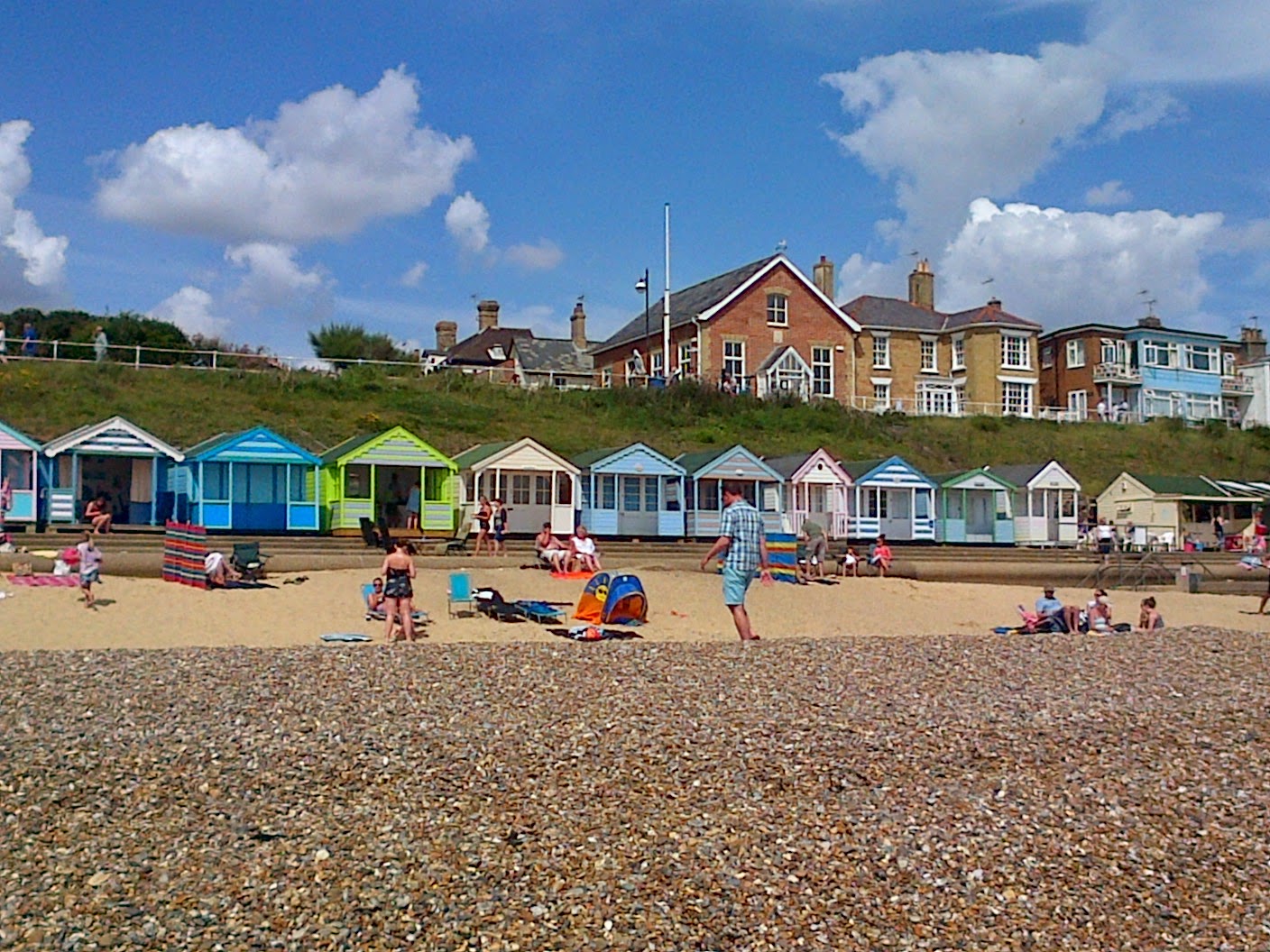
Last weekend, for an all-too-brief time, Allison and I went back to Southwold. We’ve been going there for several years now, originally as a day-trip while staying in a nearby village but more recently staying in the town itself. What with its back alleys, art galleries, occasional antique markets, the pier, the lighthouse located in the middle of the town, the iconic painted beach huts and those old cannons overlooking the sea, it’s rather old-fashioned in some ways with its emphasis, as a holiday destination, purely on the British seaside experience without the mass crowds. It is, let’s face it, a small town and the fact that holiday-makers seem unusually prone to jay-walking is better explained by the narrowness of the pavements than the sheer number of people.

This Suffolk town has a refined, almost genteel air to it not present in some of the larger seaside towns, which has led some to nickname it Hampstead-on-Sea; appropriately, one of its most famous residents was a certain George Orwell, who also lived in Hampstead for a time. Literary connections aside, the fact that Southwold is home to the Adnams Brewery is an added bonus, with many having commented on how the smell of malt from the brewery somehow blends with the sea air. The pubs, needless to say, are excellent.

On the birding front, I was on the look-out for the swallows after what we saw last year; this time, we were a bit early to see the baby swallows all lined up and ready to fly, but we did see them poking their heads out of the nests high in the rafters of the car park roof.


Down on the part-sand, part-single beach it’s clear that there are some aspects of the British seaside experience that never change. Windbreaks, sand getting everywhere, cups of tea, beach cricket, gulls on the lookout for spilled food and loud children are all present and correct. Some folks rent out the beach huts to keep all of their stuff in (I always wonder how many people decide to break the rules and spend the night in these huts in order to save on accommodation costs), while the rest of us lug our things from the car, the hotel or the B&B. Even the relative lack of mobile phone reception on the beach lends the place a timeless air.


But it cannot be denied that Southwold itself has changed in recent years as more holiday-makers discover its rather quaint charms. Tellingly, what was once a rather good second-hand bookshop on Pinkney’s Lane is now a letting agent, while a couple of independent booksellers closed down a few years ago (one cannot help but imagine Orwell turning in his grave at the very thought). In recent years, Tesco and Costa Coffee have both opened up shops in the town – the latter in particular attracting opposition from the residents of a town that already has several places where one can drink coffee – while Waterstone’s has gone down a slightly different route and opened an outlet with no company branding present (it’s simply called Southwold Books).

What hasn’t changed, though, is the inescapable fact that when you leave, you find you’re already missing the place by the time you’ve made it to the A12.

29.7.14

Evensong

London, being London, is home to many places of great historical interest, some of which can be found in the most unexpected places. Yesterday, I found myself in an oasis of (relative) tranquillity just yards from the bustle of Fleet Street which is home to one of London’s oldest churches. This area is known as the Temple, and it has the feel of a sleepy, old-fashioned university college. I, it seems, am not the first person to think this; back in the 1920s, H.V. Morton commented that the Temple "brings into the heart of a great city the peace of some ancient university town and the dignity of a past age."

It’s not really sleepy, of course – it’s one of London’s major legal districts and those seemingly quiet (and, in most cases, listed) buildings are for the most part barristers’ chambers. At its heart, though, is the Temple Church, rare among English churches on account of its being round (well, the original nave section is) and famous for its effigies (not tombs) of medieval knights. It’s a beautiful old building, and this first-time visitor was most impressed.

It dates back to the 12th century when it was built by the Knights Templar, who modelled it on the Church of the Holy Sepulchre in Jerusalem (which is why the nave is round); although the Knights Templar were abolished in 1307, their legacy lives on in the name of this particular part of London, and the curious fact that the priest-in-charge is not called the vicar but the Master of the Temple.

History has been made in the Temple Church, for it was the venue for negotiations between King John and the barons, which led to the signing of the Magna Carta in 1215. William Marshal, the knight who ensured that the Magna Carta was reissued after John’s death, is buried there. It has featured in Shakespeare’s Henry VI, Part 1 and The Da Vinci Code (that last one led to a vast increase in the number of tourists coming to have a look around; the Master has even written a book debunking the myths propagated by Dan Brown). It survived the Great Fire but was badly damaged in the Blitz, after which it was restored.

Unusually, the Temple Church is a peculiar, meaning that it is a church that does not come under the jurisdiction of the diocese in which it is located. This is not due to anything concerning the Knights Templar but because the Temple Church is the chapel of two of the four Inns of Court (the two with ‘Temple’ in their names, naturally). The most visible sign of this unusual status is that the Master and his acolytes get to wear scarlet cassocks.

So what was I doing there yesterday? The answer can be summed up in one word: Evensong.

I’ve not been to evensong since I was a chorister at John Keble Church; back then, evensong was an occasional Sunday evening affair (more often than not, evening prayers were a ‘said’ service and so did not require the choir); Temple Church, by contrast, has a cathedral-style choir that does regular choral music performances in addition to services, and has even featured on the Proms.

This particular evensong was held to commemorate the hundredth anniversary of the outbreak of the First World War. Although Britain didn’t enter the war until 4th August, 28th July marked the anniversary of the first declaration of war, that of Austria-Hungary on Serbia; five days earlier, the former had presented the latter with a series of demands that were intended to allow their authorities to investigate the assassination of Archduke Franz Ferdinand in Sarajevo, although some of them were so unreasonable that they invited rejection. In fact, the Serbs accepted all but one demand, the request that the Austrian police be allowed to operate within Serbia itself. The result of this rejection was the outbreak of war.


And so, to the accompaniment of some truly lovely choral music (including the Last Post, the Magnificat, an anthem based on the 90th Psalm and the Old Hundredth, the last of which I remember singing as a chorister, at evensong most likely), we commemorated the start of the war.