Writing Portfolio

Showing posts with label Paris. Show all posts

15.11.15

Paris: A personal reaction

Cities across the world held impromptu vigils to show solidarity with Paris last night, and London was no exception. While landmarks such as Tower Bridge and the Eye were being lit up in the red, white and blue of the French tricolour, thousands of people descended on Trafalgar Square to light candles at makeshift shrines, wave home-made banners (“nous sommes Paris”, “London stands with Paris”) and break out into a chorus of ‘La Marseillaise’ every five minutes or so.


It struck me, briefly, that the notion of singing the French national anthem in a public place named after a British victory over France might be a bit surreal. But that thought was brief, for there were much bigger forces at work, big enough to make quibbling over a name seem a little silly, if not downright petty. There are times when national differences fall aside before common values, and in the twenty-first century the wake of a terrorist attack – or rather, series of attacks – is such a time. Liberté and egalité are not so much French values these days as fairly universal values in the Western world, and the worldwide vigils were a chance for people everywhere to show a sense of fraternité with the people of Paris. Fittingly, the National Gallery and the fountains were lit up in the French colours too, and I even spotted a couple of bottles of vin rouge being passed around; very French.


I have a habit of following rolling news and social media somewhat obsessively when major events unfold, and that’s what I’ve been mainly doing since Friday night. Usually it’s with a sense of mild fascination or curiosity, wondering what’s going to happen next, but on Friday night it was with a mounting sense of horror as the news of multiple attacks filtered through and the number of dead rose into three figures. It’s quite possible that a contributing factor here was that Paris is a city that Allison and I love to visit – we were last there in June. We walk a lot when we go to Paris – it feels a lot more compact than London – and to judge by the map we’ve been within a couple of blocks of some of the places where the attacks took place; we like to stay in the 11th and have been to a few of the cafés and bars in the Canal Saint Martin area. This felt a little too close to home for comfort. Going along to a vigil in Trafalgar Square may seem like a small gesture but it felt like the right thing to do.

I’ve done plenty of reading up as well as watching the news, and here are the best pieces that I have found (with hyperlinks). The sense of immediacy and perspective on show here are much better than anything I could come up with.

In Paris, a Night Disrupted by Terror (Pamela Druckerman, New York Times) Personal account of the night by an American journalist who lives and works in Paris – a “perfectly normal dinner party” is interrupted by news of the attacks. Guests get text-messages asking if they’re OK. The writer’s husband is actually at the Stade de France (he ended up getting interviewed on Dutch radio) while another couple try to contact their teenage children. Things really hit home when she sees a map of Paris on TV showing where the attacks happened – “My home is on the other side of those two sites … it’s not just Paris that’s in the news – it’s my Paris”.

Murdered for Being Parisian (Judah Grunstein, The Atlantic) Highly erudite account from a Parisian – I had to look up what ‘desuetude’ means – which quickly focusses on the “democratization of the carnage”. “Last time,” the writer says (referring to the Charlie Hebdo attacks in January), “the victims were targeted for who they were or what they’d done. This time the bullets were not aimed, but fired at random … This time it is the nation and its people themselves in the crosshairs”. These are times, he notes, when even going out onto the streets buy a cake becomes in its own way an act of defiance. The writer goes on to consider the question of ‘self’ and ‘other’ which ties in the recent refugee crisis by referencing Parisians opening their doors to help those unable to get home (the #portsouvertes phenomenon that for a few hours gripped Twitter) – “When thousands of Parisians become refugees in Paris … there’s no longer really a “here” or a “there”, no longer a host and a refugee”.

‘Crimes’ Jihadists Will Sentence You To Death For (Jeffrey Goldberg, The Atlantic) Ties in the Paris attacks with the bombing of the Russian plane in Egypt two weeks ago, and other Islamist attacks over the years, by giving a “partial, and only partial” list of aspects of modern life that Islamist militants find intolerable to the point of killing people for partaking in them. My one quibble is the writer’s use of the term “medieval values” when talking of the extremists; sadly, religious extremism is in its own way a very modern phenomenon (for more on this, try to get hold of a copy of John Gray’s Al Qaeda and What it Means to be Modern – a short but nevertheless excellent and thought-provoking read).

After Paris, Europe may never feel as free again (Nick Cohen, Observer) Nick Cohen is a writer who I find always has something useful to say, and who usually seems to be a few steps ahead of everyone else (for example, people have only recently started to notice his excellent book What’s Left?, which was published eight years ago). He argues that, thus far, the threat posed by Islamism hasn’t really changed Europe. “From Nigeria to Afghanistan, a clerical fascist doctrine that mandates mass murder and self-murder has pushed whole regions into civil war. Yet divinely sanctioned violence has failed to engulf our continent … In spite of all provocations, we are what we once were”. Cohen, though, feels that the Paris attacks will change this; he cites the closing of international borders, which had already started in some parts of Europe as a consequence of the refugee crisis, as evidence of this.

France will not let these horrific attacks break the Parisian spirit (Mathieu Vaillancourt, Independent) As with the Grunstein article above, this one looks at how ordinary people became the targets although the focus here is on hope that Parisian life will continue unbowed. “Like Londoners or New Yorkers, Parisians are strong and stubborn people. They will proudly continue their daily lives … This is how terrorism and fanaticism will lose the propaganda battle that is being waged by extremists.” Paris, of course, has a long history of violent upheaval and there are monuments to aspects of this all over the city; in a sense this is another bloody chapter in its notably bloody history. I was especially taken by the last paragraph with its call for people to continue to visit Paris. I’ve read similar articles recently in the wake of the Sharm el-Sheikh bombing and the same thing was said after the massacre in Tunisia in June. Mass travel abroad is a relatively recent phenomenon in the wider history of mankind and it is in its own way a major means of reducing barriers (and increasing understanding) between different peoples and cultures – which is probably why the Islamist militants hate it.


The strange relationship between Islam, violence and French football (Freddy Gray, The Spectator) It somehow seems odd bringing football into this, but then one of the venues attacked was the Stade de France during an international football match. As such, it’s worth noting that football is – or at least was once considered to be – one of few areas where Muslims could be seen as successfully integrating into French culture, which might explain why Islamist extremists would choose to attack it (and it could have been a lot worse, for according to some reports one of the bombers had a ticket but had been turned away; worth bearing in mind that President Hollande was at the game). Sticking with the Stade de France for a minute, I found one of the most moving scenes on Friday night was the footage of fans singing ‘La Marseillaise’ as the (eventually) left the stadium – maybe it’s because I associate the song with that scene in Casablanca, but it’s always struck me as a particularly stirring song of defiance in the face of adversity. It later transpired that one of the French players lost a cousin in one of the other attacks, and when the German team were told that they couldn’t leave the stadium due to safety concerns the French team insisted on staying with them; as was the case with the Parisians who opened their doors to strangers, a crisis can bring out the best in people. Incidentally, the friendly between England and France on Tuesday is going to go ahead despite obvious security concerns; life, as has been mentioned above, must go on. There have already been calls for the English fans in attendance to show some fraternité and sing along to ‘La Marseillaise’ before the kick-off. I hope they do – it’s already been sung by thousands under Nelson’s Column, so why not at Wembley? These are, after all, times when national differences fall aside before common values.

30.6.15

Madeleines

Along with 13 items of vintage French pottery, a wicker basket and two fish-plates, our recent visits to the flea-markets of Paris also resulted in a set of four cast-iron saucepans which Allison convinced me would be able to fit in our kitchen. Due to all of the wine we'd also bought, fitting them into our luggage was more of an issue but Allison managed to get them into her handbag for the Eurostar journey back home! 

Allison had also visited a shop called E. Dehillerin, a famous cookware-store in the 1st arrondissement. From there she had purchased a madeleine pan, which is one of those kitchen implements that only has one purpose - the making of madeleines. 

Madeleines are those small sponge-cakes with the distinctive shell-like shapes which come from their being baked in (what else?) madeleine pans. Now that we had one of those, we couldn't not have a go at making them, could we?

Our recipe was sourced from a book called My Paris Kitchen by David Lebovitz, an American food-writer who is based in Paris. Allison is a fan although I am not so keen, having been not much taken with a previous book of his, The Sweet Life in Paris (to be precise, he lost me when he mentioned using his bathtub for doing the washing-up; as this is mentioned early on in the book, I feel that I may not have given him a fair hearing).

But this wasn't washing-up; this was the baking of a batch of small sponge-cakes which consist of eight ingredients. How hard could it be?


First up, the eggs had to be at room temperature before they could be mixed in with the sugar; Lebovitz said to do this in a mixer on high speed for up to five minutes, and then stir in the flour, salt, baking powder and vanilla (he said to use vanilla bean paste rather than extract, but he does helpfully give a quantity for vanilla extract as he evidently realises that this is what most of his readers will have; nice touch). Once this is mixed in, the batter is covered and left to stand for an hour.


In the meantime, the butter is melted and mixed in with the honey - and what better saucepan to use than one of the set from the flea-market? 


This then needs to cool down to room temperature (this recipe is, it seems, a very room temperature recipe) before being mixed in with the batter, which is then covered and left to stand for an hour.

Baking: It really is all about hurrying up and waiting.

Then came the madeleine pan. We'd bought a non-stick one and it so happens that Lebovitz recommends these, although they do still need to be greased. In My Paris Kitchen, he states that he used to use softened butter to do this, having been advised to do so by "several prominent pastry chefs" before giving melted butter a go and finding that it worked better; melted butter is, therefore, what he says to use for this in his recipe. 


The batter was then scooped into the pan (Lebovitz also goes into detail about what to use to do the scooping; I just used a couple of regular spoons) and baked for ten minutes.


They came out perfectly, more or less...


Lebovitz states that: "Madeleines are best enjoyed warm, or the same day that they're made." They most certainly were, and I have a feeling that more may be made in the future. After all, we have the pan.

26.6.15

Parisian perspectives

I have stayed in Paris on several occasions, and during those times I have never had a room (or, for that matter, an apartment) with a view that includes the Eiffel Tower. Such things, I presumed, were reserved for characters in films and TV shows (and even they seem to make do with a picture most of the time). The closest I have ever come to an eyeful of the Eiffel without having to walk out of the door came when we went to Paris last year. Our apartment in the north-east of the city (the 11th arrondissement to be precise, right next to Belleville station) may not have had a view of the tower, but the window in the hallway mere yards from our front door did. We liked the place so much that we  stayed there again when we went back to Paris last week.


One thing I really like about staying in a Parisian apartment few floors up is the view of the rooftops of the adjoining apartment buildings.


There’s something uniquely Parisian about these buildings, just like there’s something very Parisian about the way the traffic behaved at the road-junction that sits above the Belleville Métro station. This junction, which I think I’m right in saying is the only place in Paris where the boundaries of four arrondisements meet, is chaotic at best and in true Parisian style many motorists resort to using their horns. This, combined with the distinctive sirens of French emergency service vehicles, is what Paris sounds like, especially on the fifth floor when you’ve got the windows open to let some air in.


Out in the hall, we got our view of Eiffel’s Tower during the day and when we came home at night, when it is lit up. As an extra bonus, we found that every hour in the hour the whole tower sparkles for five minutes! We couldn’t let this special Parisian moment pass without a glass of wine and some musical accompaniment from the iPhone; we settled on Charles Trenet’s ‘La Mer’.


But there’s more to viewing the Paris skyline than the Eiffel Tower, right? After all, the novelist Guy de Maupassant, one of the tower’s early critics, said that he liked to dine at the restaurant on the second level of the Tower because it was the only place in Paris from which he couldn’t see it. The original plan was that it would be demolished in 1909, twenty years after it was constructed, and it was only spared because it turned out to be an ideal platform for radio antennas.

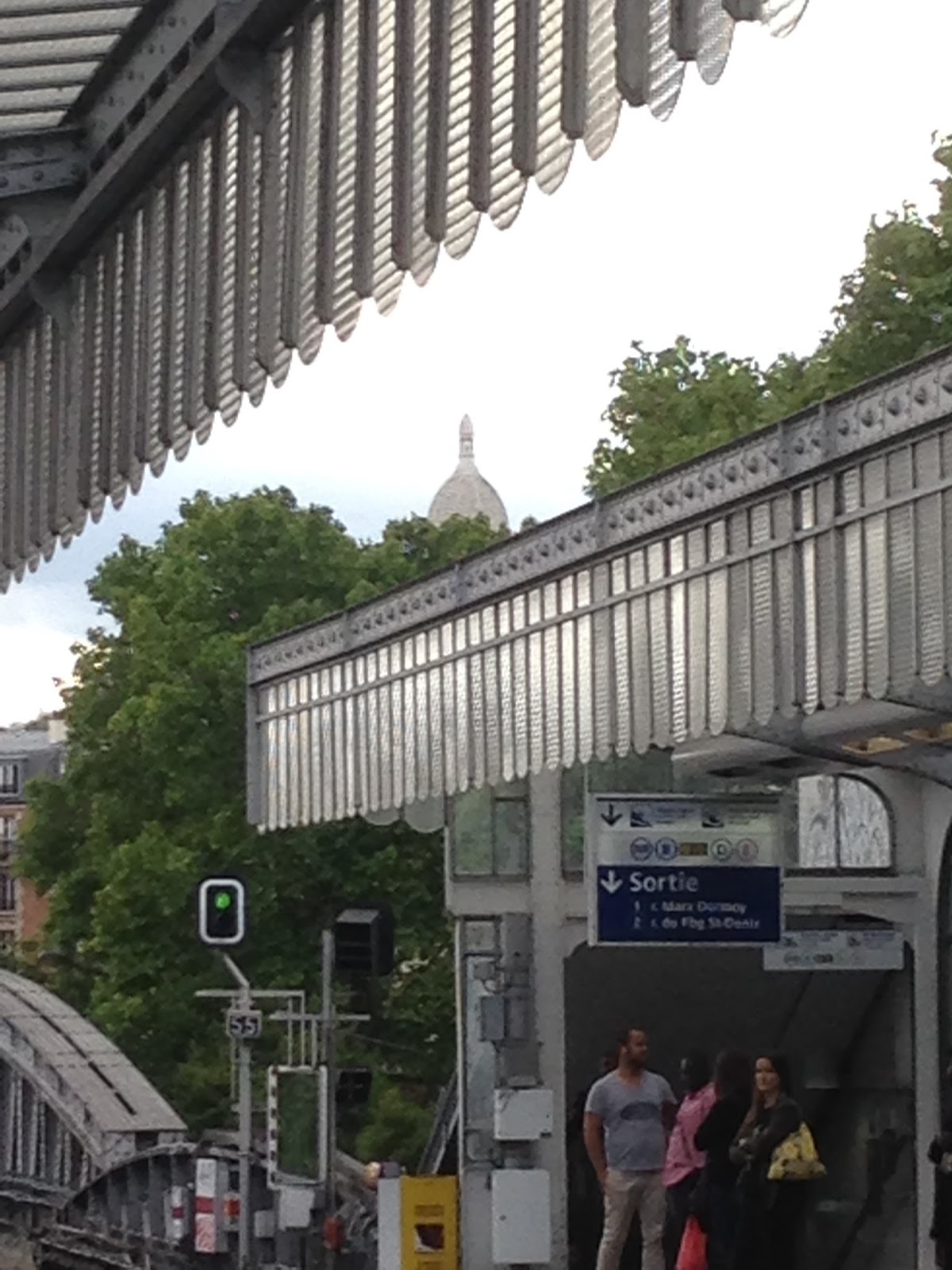
Admittedly, M. de Maupassant made his claim about his dining habits on the grounds that he hated the thing (as did a lot of snooty Parisians when it was first built; the ‘metal asparagus’ was one of its nicer early nicknames), and over my past couple of visits to Paris I’ve been checking out various viewing-pointss of the city. Is there more to it than the Eiffel Tower? It certainly seems to crop up in a lot of vistas from ground level – although it’s not the only building to do that; from the eastbound platform of the Métro station at La Chapelle (connected to the Gare du Nord via a foot tunnel, although you have to know where you’re going as the signposting isn’t the best), you can see the basilica of Sacré-Cœur.

Last year, I indulged in my love of climbing towers by going up the bell-tower at Notre-Dame Cathedral. I was rewarded with a close-up of the famous gargoyles (although to be accurate they are in fact chimeras, as strictly speaking gargoyles are the ones that are intended to be used as water-spouts) which have a permanent view over the city.

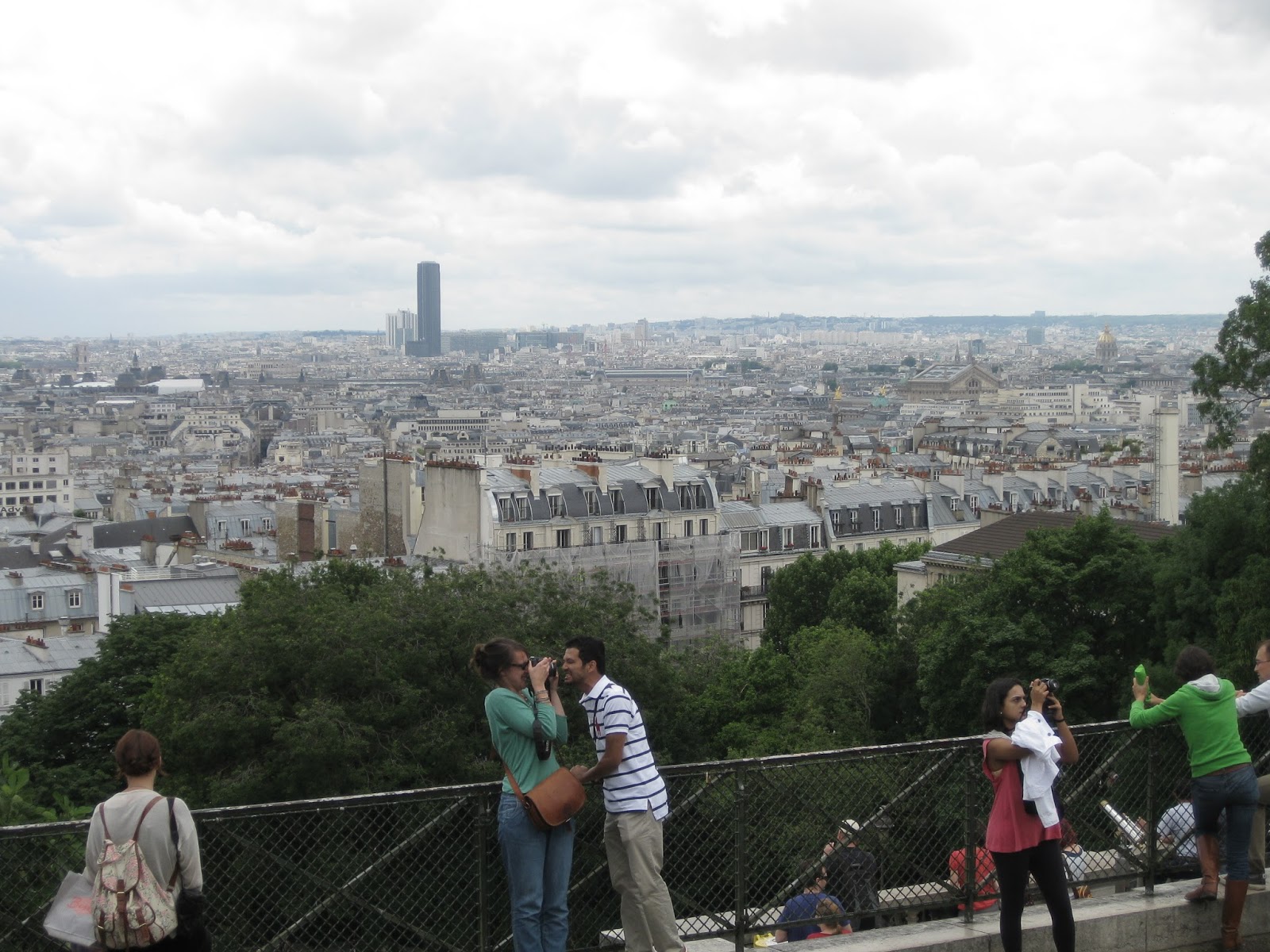
And what a view! From Notre Dame, the view is uninterrupted. One thing that’s very interesting about Paris (and which makes it distinct from London) is that the main financial district is out of town, over at La Défense at the end of the axe historique. This means that there are hardly any modern high-rise towers within the city itself, the obvious exception being the one at Montparnasse, although it’s worth noting that two years after this was built, the civic authorities passed a law banning the building of towers more than seven stories tall in the city centre.

For Paris, the happy result is that the views over the city are, by and large, unobstructed. The Arc de Triomphe and Montmartre (dominated by Sacré-Cœur) and a certain iron lattice tower can all be seen from the top of Notre Dame – as could the queue of tourists waiting to enter the cathedral (top tip: get there early; same goes for the bell tower).


But what about a panoramic view of Paris without having to climb a tower? Well, there’s always Montmartre. When we went there a few years ago, we rode up the funiculaire to the top of the hill and looked out over the city from in front of the basilica, but the view seemed somewhat restricted, and I don’t just mean by all of the other tourists and the souvenir-sellers offering plastic models of the Eiffel Tower. As you look out from Montmartre, there is a thought in the back of your head that the view from the top of the basilica behind you will be better.

Having climbed up the spiralling staircase, I can confirm that it is. All of Paris is laid out before you from the Sacré-Cœur; you can, apparently, see for almost 20 miles on a clear day.


There is, though, a spectacular panoramic view of Paris away from the tourists. For this, we need to go back to Belleville. Out in the 20th is another Parisian hill which has the Parc de Belleville on its western slope. This is the highest park in the city, and what with it being located in the 20th it is more than a bit seedy – although some would say that that makes it authentic as it must be one of the parts of the city least frequented by tourists. They’re the ones who are missing out, though, as at the park’s summit is a building called the Maison de l’Air, a small museum dedicated to the importance of fresh air, and on top of that is a viewing-platform. There, minus the tourists, is the best view of Paris.


19.6.15

'Through Paris lay my readiest path...'

When in Paris, there are a couple of places that I try to visit whenever I'm there. Or perhaps that should be 'here', as I am writing this while sipping from a glass of wine in an apartment in the 11th arrondissement.

The wine element is important here as it was purchased in our favourite Parisian wine bar, Le Baron Rouge which can be found close to the Marche d'Aligre, just south of the Rue de Faubourg Sainte-Antoine in the 12th. Aligre is a must-visit market whenever Allison and I go to Paris, and after browsing the flea-market and buying food which we will cook later, we make our way to Le Baron Rouge for a glass or two of wine.

Le Baron is truly our favourite wine-bar in Paris. It's packed with good quality wines that can be had by the glass for (usually) 3 or 4 euros a pop, and these include a few that you'd have to work hard to find in London, but it's a decidedly working-class bar (a lot of the market traders like to frequent it after a day's work) in which the pretensions that can be associated with wine-tasting are left outside.

As well as great wine, you can get platters of cheese and charcuterie (and, on Saturdays, oysters) so it's good for lunch. You can even buy wine to take away - and not just by the bottle, but by the litre (or even the five-litre plastic carton) which is drawn straight from the barrel.

Later in the day, I went to the Left Bank - specifically, the Rue de la Bucherie (within sight of Notre Dame) - to visit one of my favourite shops, Shakespeare & Company. This is a true Paris institution, an English-language bookshop that is actually three places in one - a bookshop, a second-hand bookshop (not usually located within the same establishment) and a reference library!

The place was opened in the Fifties although the founder, a visionary of sorts called George Whitman, did not originally call it Shakespeare & Company, choosing later to name it after a bookshop of that name that had existed at a different location on the Left Bank between the Wars (patrons then had included Ernest Hemingway and James Joyce).

I try and visit Shakespeare & Company every time I'm in Paris, As I usually do, I browsed the second-hand stalls outside and had a look inside (where all the new books are) before going upstairs to the reference section which doubles a sleeping-area for writers who earn their board by working on the counter during the daylight hours.

Up there, there's a piano - someone was having a go on that, and a good job she was doing - and in the front room part of the tan leather armchair was occupied by a white cat having a snooze; I presumed that this was the same cat who had been responsible for tearing up part of said leather armchair. Elsewhere in the room was a window-facing desk bearing a typewriter (anyone can have a go, apparently) and at any given time at least two would-be writers can be seen jotting something down in a notebook that is either Moleskine or a close imitation of that brand.

You can just choose a book - any book - and sit and read. I browsed, obviously; after discounting old favourites like Boswell's Life of Johnson and Eastern Approaches by Fitzroy Maclean (on the grounds that I own those, back home), I picked up a 1930s edition of Wordsworth's The  Prelude, and on flicking though it I came across the bit (in Book IX) describing  a visit he made to Paris:

Through Paris lay my readiest path, and there
I sojourn'd a few days, and visited
In haste each spot of old and recent fame
The latter chiefly...

Wordsworth was in Paris in the early 1790s, so he took in not just the sights - then as now, 'Mont Martyr' was evidently a must-visit - but also the places where key events of the French Revolution had taken place; he even describes going to the site of the Bastille - right next to what he called 'the suburbs of St. Anthony' (ie. the Rue du Faubourg Sainte-Antoine), which is of course not far from a certain present-day wine bar of my acquaintance...

And from the rubbish gather'd up a stone
And pocketed the relick...

Very interesting. In c. 1792, William Wordsworth was picking up a piece of the Bastille to take home. For me, the parallel between that and tourists visiting Berlin two hundred years later and taking a piece of the Wall as a souvenir was very striking.

Thus enlightened, I made my way back to 'our' apartment. Where I had some wine - purchased from (where else?) Le Baron Rouge.    

16.4.14

Walking the line of history

Paris is a city for walking – much more so than, say, London. When we go to Paris, we do a lot of walking, sometimes because the distance between two places doesn’t look to be that much on the map (indeed, Paris is, generally speaking, a more compact city than London), sometimes because a lot of walking is required merely to change lines at your average Métro station. Either way, a visit to Paris tends to involve a lot of walking, and I have the statistics from my pedometer to bear this out.

There are many walks that you can do around Paris, and I don’t just mean the one in the morning to the nearest boulangerie. When we were in Paris last weekend, we purchased a book containing the routes for twenty walks in the city (one for each arrondissement) which I look forward to reading in advance of our next trip there!

The focus of this post, though, concerns a straight-line walk that takes in several prominent landmarks and a lot of French history. I refer to the Axe historique (‘historical axis’), the line of monuments, squares and thoroughfares that stretches out from the centre of Paris to the west.

It begins at the Louvre, the former royal palace (built in the seventeenth century to replace the old medieval fortress) that became a museum during the 1790s and is today the most visited museum in the world. Oddly, it’s one that I’ve never felt the inclination to visit, probably due to the vast crowds and the notion that the sheer size of the place means that I probably wouldn’t know where to start. It is said that it would take nine months to see every piece of art in the place, so surely a mere afternoon can’t do it justice? But I’ll go there one day; after all, we’ll always have Paris, won’t we?

The main entrance to this mega-museum is the Grande Pyramide, the glass structure in the courtyard that was built as part of President Mitterand’s expansion project for the Louvre in the 1980s, and is today surrounded by queues of tourists all wanting to get in so they can see the Mona Lisa. By the way, the Grande Pyramide (which does indeed have an inverted counterpart below ground) does not actually have 666 panes of glass – this was an urban myth perpetuated when it was built, and was later popularised by The Da Vinci Code.


Moving away from the Louvre, the axe heads west towards the Jardin des Tuileries, but just before you get there you have the first of three arches, the Arc de Triomphe du Carrousel. This was Napoleon Bonaparte’s original arc de triomphe, built to commemorate his victories up to 1805 when he triumphed over the Austrians and the Russians at Austerlitz (the British are not alone in naming a railway station after a famous military victory) and modelled on the Roman Arc of Septimus Severus, which can be seen today in the Forum in Rome. Subsequently, the diminutive Corsican decided that he wanted something bigger and embarked on the construction of a much larger triumphal arch, although that would not be completed until the 1830s.

From the smaller, original arch, the axe continues through the Tuileries, the formal garden originally created by Catherine de Medici in 1564 and which became a public park after the Revolution (although it had in fact been open to the public since 1667). The queen of Henri II and the mother of three more Kings of France, Catherine de Medici was a political intriguer (well, she was a Medici) and a great patron of the arts – most of what she collected is now in the Louvre. She is also credited with giving French cuisine a kick-start by bringing in her own cooks from her native Florence – a cultural import continued by her cousin, Marie de Medici (the wife of Henri IV). French chefs took on the recipes and sophisticated cookery styles of the Italian upstarts, and the rest is histoire.

The Tuileries used to be the gardens of another royal palace, which stood in what is now the space between the Arc de Triomphe du Carrousel and the gardens. This, the palace to which Louis XVI was moved in 1789 so that the revolutionaries could keep a closer eye on him and which was the residence of the kings and emperors of the nineteenth century, was burned down by the Paris Commune in 1871. This in turn left an empty space between the northern and southern wings of the Louvre, thus opening up the courtyard to the Axe historique.


The gardens remain, however, to be enjoyed by tourists and promenading Parisians. Here can be found many sculptures amid the trees, while those looking for a museum on a smaller scale than the Louvre can take in the Musee de l’Orangerie (of which more in a future post). There are also various snack-stalls where you can get a croque-monsieur or a crêpe and have lunch amid the flower-beds and the statues before continuing through the park, looking ahead along the Axe historique while trying not to think about how dusty your shoes are getting.


Standing directly on the axe as one leaves the Tuileries is the Egyptian obelisk nicknamed ‘Cleopatra’s Needle’, although this one has nothing to do with Cleopatra, having been made over a thousand years before she was born. Nor is it really connected with the one in London (or, for that matter, the one in New York); this one dates from the 19th Dynasty (1292-1189 BC) and originally adorned the Temple of Rameses in Luxor before the rulers of Egypt presented it to France in 1826, and when it arrived in Paris in 1833 the king, Louis-Philippe, placed it close to the site of ... well, I’ll come to that in a moment, but while we’re on the subject of the Citizen King it’s worth noting that he was also responsible for the nearby Fontaines de la Concorde, which were heavily influenced by the fountains of Rome.

Both obselisk and fountains are located on the Place de la Concorde, the square laid out in the mid-eighteenth century. The eight female statues in the corners of the square represent what were at the time the eight largest cities in France (aside from Paris itself): Brest, Rouen, Lyon, Marseilles, Bordeaux, Nantes, Lille and Strasbourg. During the period between the Franco-Prussian War and the First World War, when Alsace-Lorraine was occupied by Germany, the latter was covered in black on state occasions.


Despite its peaceful name, the Place de la Concorde has a violent history, being one of the key locations of the guillotines during the French Revolution. It was in this square that Louis XVI met his end in 1793; subsequently, the likes of Marie Antionette and Charlotte Corday (the woman who killed the revolutionary leader Jean-Paul Marat while he was having a bath) lost their heads here, and then it was the turn of the revolutionaries Georges Danton and Camille Desmoulines (among many others) as the Revolution became the Reign of Terror – which ended with another execution, that of the arch-revolutionary Maximilien de Robsepierre.

After braving the traffic, it’s onto the Champs-Élysées. Initially, this wide boulevard is bordered by trees and it has a peaceful air that almost (but not quite) belies the large amounts of traffic on the Place de la Concorde and the six lanes of the street itself. Before long, though, the trees give way to the (very) high-end shops and the vast crowds of people who’ve come to look at them.

Originally intended as a tree-lined extension of the Tuileries Gardens, it became a fashionable avenue by the late eighteenth century, with the current buildings owing much to Baron Haussmann, the man who redesigned Paris during the period of the Second Empire (1852-70). Much-described as “the most beautiful avenue in the world”, the Champs-Élysées is certainly one of the most expensive pieces of real estate in the world. The street’s size and proximity to several major landmarks has long made it the venue of choice for military parades, including (notoriously) the German victory parade in 1940 and (famously) de Gaulle’s parade to mark the Liberation in 1944. It still hosts one every year on Bastille Day, while since the 1970s it has been the street on which the Tour de France ends.

If the Champs-Élysées is the most beautiful avenue in the world, then the roundabout at its north-western end must surely be the most insane roundabout in the world. A total of twelve roads meet at the Place Charles de Gaulle (after whom it was renamed in 1970; originally, it was the Place de l’Étoile, which explains the name of the nearby Métro station). This was planned long before the invention of the motor-car as part of Baron Hausmann’s redesigning of Paris, which did away with the old medieval streets and introduced the grand, straight boulevards that we know and walk along today.

At the centre of this place is the Arc de Triomphe – or, to give it its full name, L’Arc de Triomphe de l’Étiole (there being, as previously stated, an earlier triumphal arch). Bonaparte commissioned this massive monument in 1806, and it took three decades to build. The reliefs depict key battles of the Revolutionary and Napoleonic Wars, while the names of French victories of that period are engraved on the pillars. So big is this arch that, in 1919, an aeroplane was flown through it.


Appropriately given the military theme, directly beneath the arch is the Tomb of the Unknown Soldier, which commemorates the many soldiers of the First World War with no known grave. This is topped by an eternal flame, said to be the first such flame to have been lit in Europe since Roman times.

This was where our walk along the line of history ended, but from here the Axe historique stretches out beyond the city itself to the business district of La Défense, in particular its Grande Arche which was built to commemorate the bicentenary of the Revolution in 1989. The approximate shape of a cube, this is the third, largest and final arch of this particular line of history.


9.7.12

Going off the beaten track


One of the great things about this Paris holiday is how Allison and I have tried to stay away from the more touristy areas. Not all the time admittedly – we’ve queued with half of Paris to see Monet’s Water Lilies at the Musée de l’Orangerie, got overcharged for water in a café in the Tuileries and got trampled by camera-wielding tourists in Montmartre.

To counter this, we have been renting an apartment in the non-touristy 12th arrondissement where we are self-catering with food purchased in the local markets. We have gone out of our way to speak en francais wherever possible, although in one bar I was told by the (American) barmaid that I could use English if I wanted to.

A people-watching game that we’ve enjoyed playing on this trip has been ‘Parisian or tourist’, where we try to guess whether a random passer-by is a local or here on holiday. In some cafés, the couple at the next table have made it too easy for us by ordering their drinks in very loud English. Sometimes they even have a bratty child in tow. We have learned that in cafés like this you have to specify l’eau du robinet (tap water) in order to avoid being overcharged – lesson learned!

This afternoon, we decided to leave those sorts of places behind and spend our last full day in Paris walking along the Canal St-Martin. It’s one of the more trendy parts of Paris these days, but it’s largely escaped the attention of the tourist industry. In fact, it’s not a part of town either of us had really heard of – we were tipped off by an article in the Toronto Star which highlighted it as a part of Paris that is very much off the beaten track.

To get there, we took the Metro to the Place de la Bataille de Stalingrad, located just north of the Gares du Nord and de l’Est. Our first impression, after we’d managed to find our way out of the maze that is Stalingrad station, was that we’d stumbled on a rough part of town. The walls were covered in graffiti, and there were groups of suspicious-looking young men hanging around along the towpath. The shirtless men doing chin-ups on a climbing-frame were unnerving, to say nothing of the homeless guys with their pit-bulls. Not an area in which you’d want to flaunt your digital SLR.

At one time in the not-so distant past, the whole area was infamous for drug-dealing and the violence that came with it. Just six years ago, loads of illegal immigrants from Afghanistan camped out here. But this part of Paris is undergoing a period of change and is currently experiencing a renaissance. Cheap rents brought in the students, the artists and the hipsters, and as a result the area has become fashionable while retaining a lot of its old character.


The canal itself, built in the 1820s to link the Seine with a canal network to the north of Paris, is very picturesque with its tree-lined locks and a series of wrought-iron footbridges. For part of the way, the water level is actually higher than the streets next to it. We’d definitely picked the right day to do this, as it wasn’t too hot and the rain which we thought was coming in the afternoon failed to materialise.


Gradually, we left the gangs and the homeless guys behind and strolled past men reading the papers on benches and small play-areas where mothers took their young children. Students sat chatting by the water’s edge, and customers from a couple of bars spilled out onto the towpath. Parisians sped by on grey Velib’ bikes, which are everywhere in this city and have revolutionised how people get around (these have been copied by London with the ‘Boris bikes’).
Our walk along the canal ended near the Place de la République where the canal goes underground to continue its journey to the Seine. Close to the end, we chanced upon a cool-looking bar called Chez Prune, where the waiter wasn’t wearing a white shirt and black waistcoat, didn’t address us in English and sang along to the old song that was playing on the stereo as he got our order from the bar. What a welcome change!

It’s a world away from the tourist-trap cafés in St-Germain where people go because the likes of Pablo Picasso and Jean-Paul Sartre used to hang out there. To be honest, if Sartre were around today, I reckon Chez Prune is the sort of place where he’d be doing his thinking.

Around us, there were no loud English-speakers – everyone was speaking French. This, it seems, is where the locals go for un café or un verre de vin rouge. Any game of ‘Parisian or tourist’, would not have lasted for very long – in fact, there were only two tourists in the place, who were working hard not to blow their cover! 

6.7.12

I see dead people...


Our exploration of Paris took a turn for the macabre today as we ventured into the 14th arrondissement, south of the Latin Quarter. Twenty metres below street level is a series of underground corridors, well over a mile in length, in which vast amounts of bones and skulls are neatly packed along each and every wall. This subterranean world is Les Catacombes, the result of a plan to empty Paris’s medieval cemeteries and store the dead, or what was left of them, in a series of disused quarries south of the city centre.

The brains behind this idea, interestingly enough, was Louis XVI – the king whose actions led to the Revolution and thus to his being guillotined in 1793. In 1780, he’d decreed that the Cimitière des Invalides (Cemetery of the Innocents, the last resting-place of Parisians since the middle ages and located in what is now the Les Halles district) be closed down on the not unreasonable grounds that it was overflowing with the dead and had as such become a public health risk. Five years later, Louis decided that all of the bones in said cemetery be moved underground – specifically, to the ancient quarries below Paris that by the 1780s had also become a serious problem as they were starting to cave in. In effect, Louis was solving two problems at the same time – an exception as far as this most indecisive of monarchs was concerned.

The plan quickly expanded to take in over 150 cemeteries in the Paris area, and the transferring of the remains of generations of Parisians continued until the mid-nineteenth century. At first, the bones were just dumped in the old quarries, but over time the people in charge of this project – which continued throughout the upheavals of the Revolution, the Napoleonic Wars and beyond – started to get creative. Héricart de Thury, who was appointed Inspector-General of Ossuaries in 1810, eventually turned the Catacombes into a proper monument to those for whom it had become a final resting-place. As a result they became a popular place to visit.

Today, it’s still very popular, if the two-hour queue that we encountered was anything to go by. As is usual in such situations, we hoped that some of the people in front of us would get bored and decide to go elsewhere, and we eventually got chatting to the Americans directly in front of us.

When we got to the front, we paid our €8 and descended via a spiral staircase that looked like it had been taken from a Metro station fire exit into the subterranean world – and, after walking through several passages we came to the entrance of what was proclaimed as “l’Empire de la Mort”. Another sign advised us not to touch the bones or smoke. One can readily understand why – back in the day, this place would’ve been lit by gas rather than electricity.


Inside, we encountered rows upon rows of bones, piled up and neatly arranged. Some areas had signs indicating which cemeteries the bones had come from, and when they’d been transferred to the Catacombes. Others were fronted by quotes from various ancient poets, a couple of whose names I recognised.

It’s an eerie place down there, as you walk past hundreds of skulls neatly packed into the walls that seem to be staring right at you. Who were all these people, I wondered? What stories could they have told, and what would they have thought about becoming a tourist attraction centuries after they’d died? Is this the sort of place where we’re all going to end up at some unknown point in the future?


As one sign proclaimed: “Ou est elle la Mort? Toujours future ou passée Apeine est-elle presente, que déjà elle n’est plus


An ossuary, it seems, is a good place for contemplating one’s own mortality. Right in the middle, there’s an altar. Here, masses are occasionally held for the dead, many of whom are no doubt the ancestors of today’s Parisians. Down there, the history of the city is quite literally staring you in the face.
Not that showing marks of respect were the order of the day for all of the tourists. OK, so they’d queued for a couple of hours to get down there, but blatantly disobeying the rules about not using flash photography and doing silly poses in front of the piles of bones struck me as a little disrespectful.

That’s nothing compared to the locals who like to go down there at night for illegal raves and all sorts of other cheap thrills; if caught, these catophiles risk fines of €60. On the plus side, though, the Catacombes have served France well in the past as the tunnels were used as a headquarters by the Resistance during the Second World War. Just around the corner from where we’re staying is a memorial on a wall to one of the Maquis, Jean Tailleu, who was executed by the SS in 1944. I wonder if he spent some time hiding from the Germans below the streets?

Back in the present, I tried to rationalise things and wondered out loud why there were only skulls and bones from limbs. Where were the ribcages and the finger-bones? Maybe they don’t last as long. I tried to take some decent non-flash photographs down there, but it’s trickier than you’d think. Even using the night-time settings can only do so much in a place where it’s always darker than the night.


In the end, we decided that this is one of those places that you only need to visit the once. Like the Eiffel Tower.

After I’d climbed the stairs to get back to the world of the living, an attendant asked in English if he could check my rucksack. There are obviously some people for whom taking photos just isn’t enough.