Writing Portfolio

Showing posts with label Suffolk. Show all posts

24.8.17

Dunwich

To Suffolk, and a chance to take a look at a town that no longer exists.

Well, sort of. Today, Dunwich is a small coastal village with a quiet shingle beach from which you can see Southwold – key landmarks being St Edmund’s church and the lighthouse – to the north and the dome of the Sizewell power station to the south.


There are low cliffs at the back of the beach. It’s part of an AONB (Area of Outstanding Natural Beauty – to all intents and purposes, one level down from a National Park) and has a couple of nature reserves in the vicinity, most notably the birding heaven that is the RSPB’s Minsmere reserve just to the south. The sort of place where a P.D. James murder mystery might take place. As you drive into the village, though, the ruins of a Medieval monastery give an indication that at some point, Dunwich was much bigger than it is today.

Back in the Middle Ages, Dunwich was a thriving port town – one of the most important on the east coast of England. In the Dark Ages it was known as Dummoc and was the capital of the Kingdom of the East Angles. It was considered important enough for the Knights Templar to build one of their churches there (similar in structure to London’s Temple Church, apparently), and several monastic orders had priories there. Recent archaeological discoveries have shown that ship-building was a major local industry.

So what happened? Dunwich has often been described as a town that was lost to the sea, which is partly true as much of the old town now lies beneath the waves as a result of centuries of coastal erosion. Storms also played a part too, though, for much of the damage was done by six big storms – one in 1286 and two more the following year, then another in 1328, another in 1347 and the last in 1362 – which between them destroyed much of the town. Subsequently, it was largely abandoned and as a result sea defences were not maintained – which meant that over time the cliffs were eroded over time, causing the ruins atop them to fall into the sea as the cliffs receded. The last of the Medieval town’s eight churches, All Saints, was abandoned in the eighteenth century and gradually fell into the sea in the early twentieth.

Local legend has it that the bells of the vanished churches can still be heard from the sea on calm nights!

In recent years, Dunwich has attracted much attention from marine archaeologists who have used sonar and acoustic imaging cameras to map the seafloor all around what used to be the town. Ruins were identified, which were subsequently examined by divers. This has made Dunwich the largest underwater medieval site in Europe, while back on land it has also featured on Time Team.

The monastic ruins that survive today do so on account of the fact that Dunwich’s Franciscan priory was built to the west of the town. The ruins of the Greyfriars (so called because the Franciscans wore grey robes) are the last of what remains of Medieval Dunwich.


The priory was closed down in 1538 during the Dissolution of the Monasteries; it was later rebuilt during the eighteenth century but then demolished in the nineteenth, leaving the monastic ruins that we see today. There’s a very nice short circular walk in Dunwich that takes you from the entrance to the car park at the beach, along the top of the cliffs, past the Last Grave (all that’s left of the churchyard of All Saints) and then right past the Greyfriars before you head back to the beach.


Definitely worth a visit if you’re in the area!

6.4.16

Something fishy...

To Southwold once again, where on our last day we drove down to the harbour for lunch before heading home on the A12. Located about a mile south of the town, Southwold Harbour is home to the local fishing fleet and a variety of huts that appear a little ramshackle at first glance. Don’t be fooled, though; one of these is home to the Sole Bay Fish Company which, in addition to having a fantastic fish counter where you can buy fish directly from the people who caught them (and in some cases smoked them too), has its own fish restaurant that’s only open at lunchtime.


Lunch was really good – although we were told before we even ordered that we couldn’t order anything from the giant fish-tank which contains North Sea fish! After oysters and crevettes (large prawns) for starters, we went for fish and chips, served on wooden platters with the chips in a metal container, in contrast to the mixed selection of plates on the table that we had used for the starters (I had the Dover sole, while Allison went for the lobster!). A lovely little restaurant, and full of character – we’ll be going there again, I have no doubt.


Although this was the first time we’ve eaten there, we have popped into the Sole Bay Fish Company for fish-buying purposes before – last time we were there, we got some very reasonably-priced Dover soles which we took home and, after consulting our recipe books, used to make sole meunière as laid out in Rick Stein’s Seafood (which also had instructions for skinning and pan-frying a flat fish; nice touch). This time, we had a look at the counter and picked up a smoked mackerel and a monkfish tail; fancy, that last one, but no doubt it would be delicious. They were kind enough to put a bag of ice in with the fish for the journey home.


Back home, there was one thing to do with the magnificent-looking smoked mackerel and that was to make the smoked mackerel paté in Delia Smith’s Complete Cookery Collection that’s been a favourite of mine for years (usually, we just use supermarket-bought fillets for it); quite simply, the ingredients – mackerel (suitably filleted), cottage cheese, crème fraiche, lemon juice – all get blitzed in a food-processor, with some pepper, salt and nutmeg mixed in.


And what of the monkfish? That was clearly another question for our cookery book collection, and I found the answer (once again) in Rick Stein’s Seafood – roast monkfish with crushed potatoes, olive oil and watercress; something of a less-is-more approach which I have come across in Rick Stein’s recipes before. For him, the fish is very much the main event here, with no need for too much extravagance to back it up. I like that.


The tail required filleting – an easy enough task (I speak as someone who’s done a seafood cookery course at Billingsgate Market and owns a suitably thin and suitably sharp fish-cutting knife); it was then salted and left for 15 minutes while I boiled up some new potatoes. The fish was fried in olive oil before being popped in the oven – the intention was to brown it although mine were still white after the recommended frying-time.


While the fish cooked, I sorted out the potatoes. Rick Stein’s recipe said to add watercress to the potatoes once they’d been crushed but we didn’t have that; we did have some rocket, though, so I improvised – the rocket was wilted in the frying-pan I’d used for the fish, and when I’d drained and crushed the potatoes with some olive oil (with a fork, as suggested!) the rocket was mixed in.


I must admit I was a bit sceptical – this sounded a little bit too easy. Also, the fish hadn’t exactly browned in the frying-pan, and they were still most definitely white when they came out of the oven. So after slicing them I quickly did them in the pan on a high heat for a couple of minutes to give them some colour. Oh, and some olive oil and balsamic (I am not a fan of vinegar but I went along with that) were drizzled on the side.


The result looked pretty fancy; which, I suppose, is what comes from serving the main event on top of the potatoes rather than next to them, and drizzling oil and balsamic around the sides. More to the point, it tasted very good too.

7.8.14

Back to Southwold

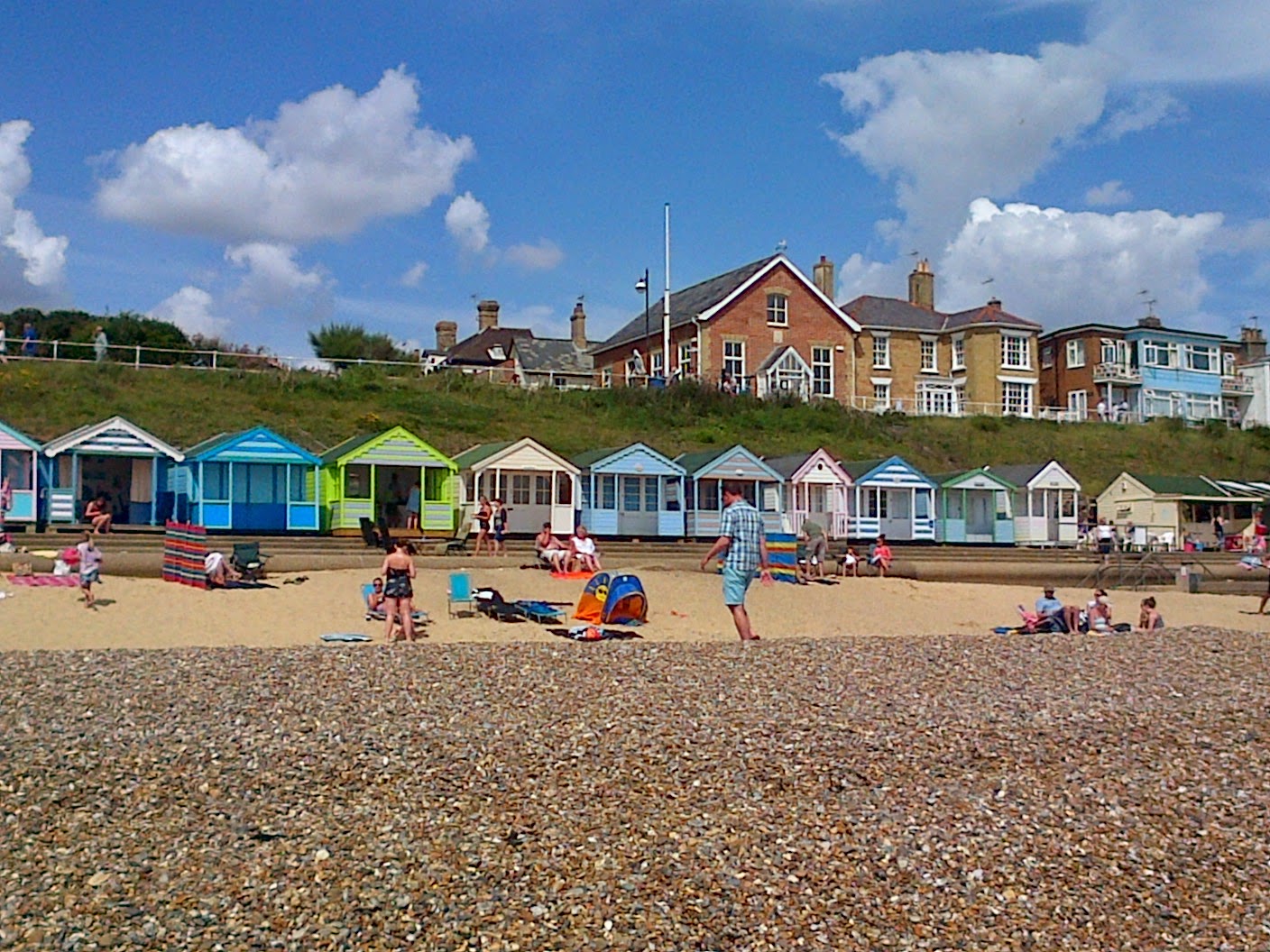
Last weekend, for an all-too-brief time, Allison and I went back to Southwold. We’ve been going there for several years now, originally as a day-trip while staying in a nearby village but more recently staying in the town itself. What with its back alleys, art galleries, occasional antique markets, the pier, the lighthouse located in the middle of the town, the iconic painted beach huts and those old cannons overlooking the sea, it’s rather old-fashioned in some ways with its emphasis, as a holiday destination, purely on the British seaside experience without the mass crowds. It is, let’s face it, a small town and the fact that holiday-makers seem unusually prone to jay-walking is better explained by the narrowness of the pavements than the sheer number of people.

This Suffolk town has a refined, almost genteel air to it not present in some of the larger seaside towns, which has led some to nickname it Hampstead-on-Sea; appropriately, one of its most famous residents was a certain George Orwell, who also lived in Hampstead for a time. Literary connections aside, the fact that Southwold is home to the Adnams Brewery is an added bonus, with many having commented on how the smell of malt from the brewery somehow blends with the sea air. The pubs, needless to say, are excellent.

On the birding front, I was on the look-out for the swallows after what we saw last year; this time, we were a bit early to see the baby swallows all lined up and ready to fly, but we did see them poking their heads out of the nests high in the rafters of the car park roof.


Down on the part-sand, part-single beach it’s clear that there are some aspects of the British seaside experience that never change. Windbreaks, sand getting everywhere, cups of tea, beach cricket, gulls on the lookout for spilled food and loud children are all present and correct. Some folks rent out the beach huts to keep all of their stuff in (I always wonder how many people decide to break the rules and spend the night in these huts in order to save on accommodation costs), while the rest of us lug our things from the car, the hotel or the B&B. Even the relative lack of mobile phone reception on the beach lends the place a timeless air.


But it cannot be denied that Southwold itself has changed in recent years as more holiday-makers discover its rather quaint charms. Tellingly, what was once a rather good second-hand bookshop on Pinkney’s Lane is now a letting agent, while a couple of independent booksellers closed down a few years ago (one cannot help but imagine Orwell turning in his grave at the very thought). In recent years, Tesco and Costa Coffee have both opened up shops in the town – the latter in particular attracting opposition from the residents of a town that already has several places where one can drink coffee – while Waterstone’s has gone down a slightly different route and opened an outlet with no company branding present (it’s simply called Southwold Books).

What hasn’t changed, though, is the inescapable fact that when you leave, you find you’re already missing the place by the time you’ve made it to the A12.

31.8.13

Birds of Southwold


Going to the seaside always provides good bird-spotting opportunities, and earlier this month I am pleased to report that Southwold was no exception.

Gulls tend to come first when talking about seaside birds, mainly (I suspect) due to the fact that they are both ubiquitous and noisy – if anything’s going to wake you up at six in the morning on a seaside holiday, you can bet it’s going to be the gulls.

To me, they can be confusing sometimes. In Britain, the common gull isn’t really that common, while the black-headed gull does not actually have a black head (it’s brown, but only in the summer). Throw in the problems of identifying the juveniles, which all look the same for the most part, and the birdwatcher who sees a lot of gulls can be in for an interesting time. On more than one occasion I have sat in a crowded hide and heard someone ask if a gull expert is present so that some identifications can be made.

The most abundant gulls at Southwold were the two I expected to be the most abundant – those of the black-headed and herring varieties.

The herring gull is, I suspect, what most peoples’ idea of a gull is; a big, powerful-looking beast with grey wings a red tip on its beak. Its ‘kyow’ call is truly one of the sounds of the seaside (they’re the alarm clock ones). These are the ones who will try to take your chips if you should happen to want to eat them while walking along the prom.

The black-headed gulls had, for the most part, already reverted to their winter plumages. They’re among the smallest of British gulls, and are the ones you’re most likely to find inland. They’ll eat practically anything, and as they tend to go around in groups their harsh-sounding ‘kree-aaa’ call is fairly ubiquitous, albeit not as piercing as the call of the afore-mentioned herring gull.

I did get to see one other gull on the beach when I went for a walk shortly before dusk. It was a tidy-looking thing, the size of a black-headed gull but its yellow beak and lack of any dark markings on its head told me this was something different; after consulting my field guide I concluded that it was a common gull.

Elsewhere, I saw a family of swans – partly obscured by reeds it must be said – and a solitary pied wagtail trying not to get blown away by the wind. House martins flew overheard down at the harbour, where crows and magpies could be seen fighting with the gulls over scraps.


But the best sighting of them all occurred just after we arrived in Southwold. We parked the car behind the hotel, and there in the roof of the carpark was a family of swallows – five babies waiting patiently for their parents to arrive with insects that they’d caught. My field guide tells me that a brood of swallows eats around 6,000 insects a day, and these little ones were getting fed by mum and dad every few minutes! The arrival of one of their parents was the cue for much noise as they all tried to get parental attention and the feed that went with it. They must have been almost ready to fly.


The following morning, I went down to look at them again and found just one there, looking rather forlorn it must be said. After breakfast, I went back and found that he’d been rejoined by his brothers and sisters, who’d moved a few rafters down. Later on, they’d all gone out flying.

It is hard to think that, within a month, these little birds will be flying all the way to Africa for the winter.

14.8.13

Spirit of Broadside

One thing I love about going to the Suffolk coast – along with the abundant birdlife, the opportunities for swimming in the sea and the chance to temporarily escape from London in the old-world charm of Southwold – is the chance to sample Adnams beer.

Although occasionally available as a guest beer at certain pubs in London, Adnams comes into its own in its home town of Southwold where the range available in any given pub is fantastic. From the dark, full-flavoured Gunhill to the golden, citrus-tasting Spindrift to the strong Broadside ale (not recommended as a session beer!), every Adnams beer is a winner as far as I am concerned.

Adnams, which somehow managed to escape being taken over by the various brewing conglomerates of the 1960s and 70s, was still using a horse-and-dray to delivery beer to pubs in Southwold less than a decade ago but has in recent years modernised in a big way. Nowadays, they have a state-of-the-art distribution centre a couple of miles inland, and in Southwold itself they have an excellent shop which sells fancy cooking equipment and fine wines in addition to many bottles of their beer. Now that is my kind of shop, and it’s a must-visit every time we go to Southwold.

For the past couple of years, it has been branching out and distilling spirits as well – which is not something most breweries would contemplate doing (they completed work on the Copper House Distillery, located next to the brewery in the heart of Southwold, in 2010). As a result, you can now get Adnams gin and vodka, as well as liqueurs like limoncello. Adnams has already started to pick up awards for its spirits, which shows that they’re taking it seriously and are being taken seriously. There’s a whisky too, although as the rules for whisky production state that it has to be matured in wood for at least three years, it’s not available to buy yet. Give it time, though. Good things do come to those who wait, right?

This merger of brewing and distilling has perhaps reached its apogee, though, with a new drink called Spirit of Broadside. What they’ve done is taken Broadside, distilled it and matured the result in oak casks for a year. People seem to be doing a lot more with beer these days – just look at the increasing number of microbreweries and the rise of the beer cocktail – but I haven’t come across anyone distilling it before (unless of course we want to define the fermented grain mash that gets distilled to make whisky as beer, and as far as I’m aware that is not the done thing). There isn’t even a proper name the resulting product – the three-year rule aside, it can’t be called whisky as there were hops involved in the making of the beer, although Adnams helpfully describes it as eau de vie de biere. Naturally, I couldn’t resist this.

The result is a warm, spicy-but-smooth drink, not really like any whisky, or indeed any liqueur, that I’ve tasted. The best way I can describe it is the result of someone combining a very good beer with a fine whisky, albeit in a much classier way than the whisky chaser.

Spirit of Broadside was introduced into the growing Adnams range last year, and if you are a beer-lover and can get hold of a bottle, it’s worth a try.

Broadside, which gets its name from the simultaneous (or near-simultaneous) firing of all of the canons on one side of an old ship-of-the-line, was first brewed in 1972 to commemorate the 300th anniversary of the Battle of Sole Bay, and Spirit of Broadside in turn commemorates the 40th anniversary of what has become one of their most popular beers.

The Battle of Sole Bay (sometimes written as Solebay) was fought just off the coast of Southwold in 1672. It was part of the Anglo-Dutch Wars – that now-largely-forgotten series of conflicts in the mid-to-late seventeenth century over control of the seas and trade routes. The battle itself was an indecisive affair. The Dutch fleet surprised a joint Anglo-French fleet at anchor in Sole Bay but was unable to press home its advantage when the wind changed. Today the battle is perhaps best known for the fact that one of the English admirals, the Earl of Sandwich, was killed. He was not the inventor of the sandwich – that was a later earl who was also an admiral – but he was the patron and benefactor of one Samuel Pepys; when Pepys refers to ‘my Lord’ in his diary, he’s referring to him.

The battle is commemorated in Southwold in lots of ways – it’s depicted on the town sign, there’s a plaque commemorating the house where the navy’s commander-in-chief (the Duke of York, later James II) stayed, and there are cannons facing out to sea on the town’s various greens. Plus, of course, the name of the battle is the name of the brewery.


It all, apparently, comes back to the beer.