Writing Portfolio

Showing posts with label the seaside. Show all posts

3.7.18

Looking out for seabirds off Tenby

To Tenby, where the weather was glorious last week and where I was very keen to go on one of the various boat trips. You can go on one to Caldey Island, which is just over half a mile south of the mainland and which is home to a monastic community (thus making it one of Britain’s holy islands, for there has been a monastery there since the sixth century; admittedly it was closed down during the Dissolution, but an abbey on the island was rebuilt in 1910, originally for Anglican Benedictines although it’s now occupied by Cistercians). You can go mackerel-fishing or seal-watching. Or you can go on an island cruise which lasts for about an hour and doesn’t land at Caldey, although it does take you to see the bird sanctuary on the smaller, neighbouring St Margaret’s Island which has no public access.


I chose the latter as I was very keen to see the seabirds; the Puffins especially appealed, mainly because I think they’re fascinating birds but also because there was a big feature on them in the most recent issue of the RSPB members’ magazine Nature’s Home. Also, it has to be said, Allison had seen loads of them on a boat trip when she went to Newfoundland recently and yes, I was feeling a little bit jealous about that (what we in Britain know of as a Puffin – which, as it happens, is the provincial bird of Newfoundland & Labrador – is known internationally as the Atlantic Puffin, for there are two other species of this diminutive yet very distinctive seabird that can be found in the northern Pacific Ocean).

I bought my ticket from one of the wooden booths by the Harbour that sells the tickets for the variety of boat trips on offer. I was advised that, as the tide was low, the trip would be setting off not from the Harbour but from the nearby Castle Beach which has a mobile jetty which is used by the various boat trip operators at low tide, and which is manoeuvred into position by a tractor. The boat was due to sail from there at 3:30pm but the booth-lady reckoned I should be there ten minutes beforehand. Castle Beach is one of the four golden-coloured beaches that adorn Tenby and which are key to this walled Pembrokeshire town being a very popular holiday destination. There’s a tidal island there, St Catherine’s, which you can walk out to at low tide although it’s closed to the public. On it is a fort, one of the Palmerston Follies that were built in the 1860s when there was a war threat with the French; never used for its intended purpose, it has at various times been a private house and even a zoo. Nowadays it is apparently open to the public on a very occasional basis (according to a series of posters that can be seen on the walls of several of the town’s hotels and B&Bs) and two years ago it appeared on TV as the high-security ‘Sherrinford’ prison in Sherlock. But I digress.


Anyway, at the appointed hour of 3:20pm I and a couple-of-dozen others who’d paid their £14 were there on the beach, forming a reasonably orderly queue by the tractor amid the holiday-makers who were simply there to catch the sun and occasionally go and cool off in the sea, and very nice weather it was for that. Come 3:35 I was wondering if our boat was going to actually show up, for the only vessels that had come along to the jetty had done so to unload passengers and none of them even remotely resembled the yellow catamaran that had adorned the Tenby Boat Trips board that I’d seen when I’d bought my ticket. Then, said yellow catamaran (“designed especially to cruise the beautiful coastal water around Tenby … unique shape makes for a very comfortable, stable ride”) hove into view and we passengers dutifully trooped on board.


After the safety announcements we were off, heading out into Carmarthen Bay. While we weren’t going to be landing at Caldey Island, we did go past the jetty on our way to St Margaret’s Island, which is where the main seabird colony is located. Although it’s uninhabited by people now, St Margaret’s Island bears the evidence of human activity in the form of some disused housing for workers who quarried limestone on the island until 1851. Nowadays it’s a Site of Special Scientific Interest (SSSI) as well as being a part of the Pembrokeshire Coast National Park (as is Tenby, for that matter). 


As we approached it, we saw plenty of gulls (three types of those – Herring, Lesser Black-backed and Greater Black-backed) circling and calling ahead, quite a few Cormorants and some low-flying birds, dark on top and white underneath, which it took me a minute or so to realise were either Guillemots or Razorbills, depending on what their beaks looked like!

The boat hove to underneath the cliffs so we could all get a good view of the birds. Atop the cliffs were the Cormorants, St Margaret’s being home to one of the largest Cormorant nesting-sites in England and Wales. Below them, perches on the ledges on the cliff-face, were the Guillemots and Razorbills – both members of the auk family and thus related to the Puffins although they are larger; the Guillemots are the largest with their slender heads and pointed beaks, whereas the Razorbills (black rather than brown) are more stocky-looking with thick, blunt beaks that have a white line on them. They and the Puffins have similar lifestyles – they spend much of their time at sea and only come to land in order to nest.

Alas, despite much looking with the binoculars I didn’t see any Puffins (I’m reminded of an old postcard which has a drawing of a Puffin on top of a cliff next to a drawing of the same cliff-top without the Puffin, captioned ‘nuffin’). They nest at the top of the cliffs in burrows, and their numbers at St Margaret’s are much smaller than those of the other birds (no more than a couple-of-dozen nesting pairs) because of the rats. St Margaret’s can be accessed from Caldey at low tide, and the rats on Caldey make their way across and eat Puffin eggs and chicks. Apparently there are plans afoot for dealing with Caldey’s rats, which is good news for the Puffins’ future.

And they need some good news. At the moment, their numbers are in decline in Iceland, Greenland, the Faroes and Norway as well as the British Isles. They are currently designated as ‘vulnerable’ by the International Union for the Conservation of Nature (IUCN) while my RSPB field guide has them as an amber species. Getting rid of the rats on Caldey Island to help the Puffins on St Margaret’s may be a small step but it’s a step in the right direction; they managed it on Lundy Island, which is some thirty-odd miles due south of Caldey.

As well as two out of the three possible auk sightings, there were plenty of gulls. As well as the usual species – Herring, Lesser Black-backed, Greater Black-backed – I was delighted with a much rarer sighting, that of a Kittiwake. Much more of a marine bird, this one is hardly ever seen on land except when it’s nesting. When did I last see one of those? To be honest, I’m not sure if I ever have for most of my seabird-watching is done from the land. I really should do these boat trips more often! Down by the sea, a small Cormorant turned out to be a Shag (cue the jokes; sometimes bird names do birdwatchers no favours!).

Cruising along by Caldey, after seeing plenty of Cormorants fishing out at sea, we stopped by a rocky outcrop which is home to a Herring Gull colony, where we were able to see the chicks, almost but not quite ready to start flying, wandering around. Oystercatchers also abounded, but in between them I noticed a small brown bird, similar-looking to a thrush but smaller, which I was happy to identify as a Rock Pipit (“breeds along the rocky shorelines and on small islands around the coasts of Britain and Ireland … avoids sandy beaches … rare inland”). I saw a couple more before we moved on.


It’s possible to see seals in the sea off Tenby, but today wasn’t our day for that. We did see a few jellyfish towards the surface, though; later, while walking along the beach, I saw one that had quite literally been left high and dry by the tide. As the boat made its way back to Castle Beach and the old fort on St Catherine’s (home to quite a few Jackdaws if nothing else), I scanned the surrounding area with my binoculars once more, and was rewarded for my efforts with the sight of a Gannet diving head-first into the sea.


Even though I didn’t get to see any Puffins, I found the trip to be most enjoyable and was able to add a fair few species to my ‘seen in 2018’ list.

7.8.14

Back to Southwold

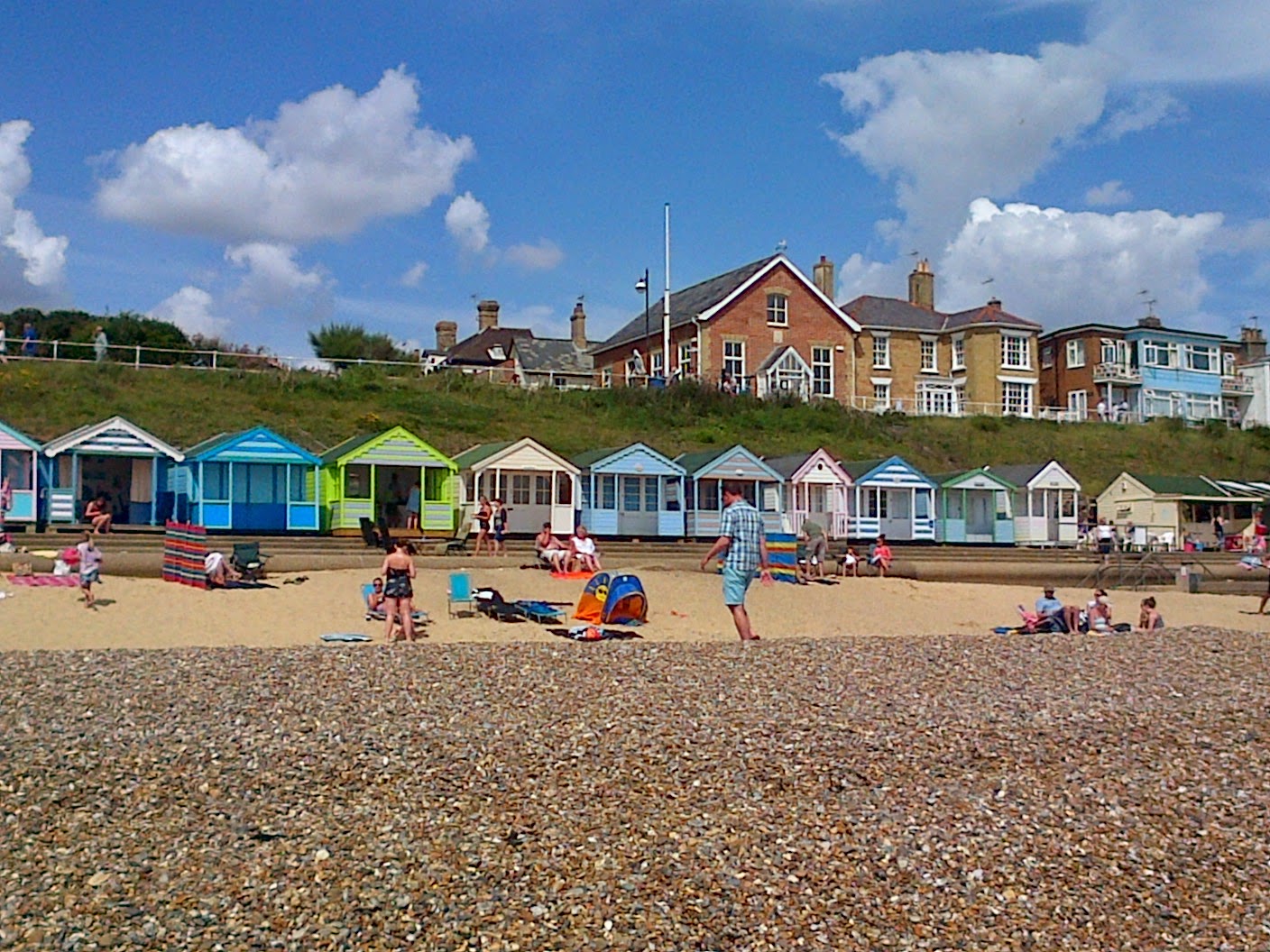
Last weekend, for an all-too-brief time, Allison and I went back to Southwold. We’ve been going there for several years now, originally as a day-trip while staying in a nearby village but more recently staying in the town itself. What with its back alleys, art galleries, occasional antique markets, the pier, the lighthouse located in the middle of the town, the iconic painted beach huts and those old cannons overlooking the sea, it’s rather old-fashioned in some ways with its emphasis, as a holiday destination, purely on the British seaside experience without the mass crowds. It is, let’s face it, a small town and the fact that holiday-makers seem unusually prone to jay-walking is better explained by the narrowness of the pavements than the sheer number of people.

This Suffolk town has a refined, almost genteel air to it not present in some of the larger seaside towns, which has led some to nickname it Hampstead-on-Sea; appropriately, one of its most famous residents was a certain George Orwell, who also lived in Hampstead for a time. Literary connections aside, the fact that Southwold is home to the Adnams Brewery is an added bonus, with many having commented on how the smell of malt from the brewery somehow blends with the sea air. The pubs, needless to say, are excellent.

On the birding front, I was on the look-out for the swallows after what we saw last year; this time, we were a bit early to see the baby swallows all lined up and ready to fly, but we did see them poking their heads out of the nests high in the rafters of the car park roof.


Down on the part-sand, part-single beach it’s clear that there are some aspects of the British seaside experience that never change. Windbreaks, sand getting everywhere, cups of tea, beach cricket, gulls on the lookout for spilled food and loud children are all present and correct. Some folks rent out the beach huts to keep all of their stuff in (I always wonder how many people decide to break the rules and spend the night in these huts in order to save on accommodation costs), while the rest of us lug our things from the car, the hotel or the B&B. Even the relative lack of mobile phone reception on the beach lends the place a timeless air.


But it cannot be denied that Southwold itself has changed in recent years as more holiday-makers discover its rather quaint charms. Tellingly, what was once a rather good second-hand bookshop on Pinkney’s Lane is now a letting agent, while a couple of independent booksellers closed down a few years ago (one cannot help but imagine Orwell turning in his grave at the very thought). In recent years, Tesco and Costa Coffee have both opened up shops in the town – the latter in particular attracting opposition from the residents of a town that already has several places where one can drink coffee – while Waterstone’s has gone down a slightly different route and opened an outlet with no company branding present (it’s simply called Southwold Books).

What hasn’t changed, though, is the inescapable fact that when you leave, you find you’re already missing the place by the time you’ve made it to the A12.

31.8.13

Birds of Southwold


Going to the seaside always provides good bird-spotting opportunities, and earlier this month I am pleased to report that Southwold was no exception.

Gulls tend to come first when talking about seaside birds, mainly (I suspect) due to the fact that they are both ubiquitous and noisy – if anything’s going to wake you up at six in the morning on a seaside holiday, you can bet it’s going to be the gulls.

To me, they can be confusing sometimes. In Britain, the common gull isn’t really that common, while the black-headed gull does not actually have a black head (it’s brown, but only in the summer). Throw in the problems of identifying the juveniles, which all look the same for the most part, and the birdwatcher who sees a lot of gulls can be in for an interesting time. On more than one occasion I have sat in a crowded hide and heard someone ask if a gull expert is present so that some identifications can be made.

The most abundant gulls at Southwold were the two I expected to be the most abundant – those of the black-headed and herring varieties.

The herring gull is, I suspect, what most peoples’ idea of a gull is; a big, powerful-looking beast with grey wings a red tip on its beak. Its ‘kyow’ call is truly one of the sounds of the seaside (they’re the alarm clock ones). These are the ones who will try to take your chips if you should happen to want to eat them while walking along the prom.

The black-headed gulls had, for the most part, already reverted to their winter plumages. They’re among the smallest of British gulls, and are the ones you’re most likely to find inland. They’ll eat practically anything, and as they tend to go around in groups their harsh-sounding ‘kree-aaa’ call is fairly ubiquitous, albeit not as piercing as the call of the afore-mentioned herring gull.

I did get to see one other gull on the beach when I went for a walk shortly before dusk. It was a tidy-looking thing, the size of a black-headed gull but its yellow beak and lack of any dark markings on its head told me this was something different; after consulting my field guide I concluded that it was a common gull.

Elsewhere, I saw a family of swans – partly obscured by reeds it must be said – and a solitary pied wagtail trying not to get blown away by the wind. House martins flew overheard down at the harbour, where crows and magpies could be seen fighting with the gulls over scraps.


But the best sighting of them all occurred just after we arrived in Southwold. We parked the car behind the hotel, and there in the roof of the carpark was a family of swallows – five babies waiting patiently for their parents to arrive with insects that they’d caught. My field guide tells me that a brood of swallows eats around 6,000 insects a day, and these little ones were getting fed by mum and dad every few minutes! The arrival of one of their parents was the cue for much noise as they all tried to get parental attention and the feed that went with it. They must have been almost ready to fly.


The following morning, I went down to look at them again and found just one there, looking rather forlorn it must be said. After breakfast, I went back and found that he’d been rejoined by his brothers and sisters, who’d moved a few rafters down. Later on, they’d all gone out flying.

It is hard to think that, within a month, these little birds will be flying all the way to Africa for the winter.

23.7.13

Beside the seaside

A couple of weekends ago we were down in Kent visiting relatives. Saturday saw us taking in Canterbury and Whitstable, while on Sunday the weather seemed perfect for a trip to the seaside.

The car park for Dymchurch beach, located slap-bang next to a Martello tower, was full up, with people trying all sorts of innovative ways to leave their cars without blatantly box anyone in. Everyone paid at the meter, though (we lucked out as someone was leaving as we turned up).

The Martello tower serves as a reminder of the various anti-invasion schemes that have left their mark on the Kentish coast, which is littered with reminders of the past. Nearby Hythe is one of the old Cinque Ports, the Royal Military Canal passes through these parts and in addition to the Martello towers, of which there are several, Dymchurch has a redoubt that was built during the Napoleonic Wars but was later used in both World Wars (even today, it’s still owned by the MOD).

Defence these days is more a question of sea-defences, and Dymchurch’s sea wall is are brand new. The town itself is a mixture of pubs, beach-themed newsagents and fish-and-chip shops which we decided not to trouble ourselves with – being on the beach was the priority here.

On the beach, the holiday-makers who’d crammed into the car park were more spread out. Sandcastle-making and beach cricket are as popular as they were when I was a kid, I was pleased to note. And we weren’t the only ones with folding chairs and a tartan car-rug.

Several people had decided to top-up the sunburns they’d obviously been working on the previous day, and while doing so they happily showed off their rather dubious-looking tattoos. The best (or worst) was the man who had the word ‘LOSER’ tattooed across his stomach. People can be very strange sometimes.

I continued my habit of swimming in any available body of water with a dip in the English Channel. After a couple of hours, the tide started to come in. We retreated back to the car and decided to see what Hythe had to offer.

Well, the shingle beach was certainly a lot quieter, with kayaking and sea-fishing being the activities of choice. We walked along the prom in the sun, wondering about what it would be like to live in one of those houses that overlooks the beach and seeing how the sea-fishers were doing. We considered getting something from an espresso-stand operating out of the back of an Ape van, but thanks to the weather we opted for some ice cream instead.


All is well at the English seaside. And yes, I do like to be beside it.