Writing Portfolio

8.2.13

Rewriting history?

Poor old Tony Robinson. For almost two decades, he’s fronted a TV show which has seen him and a handful of archaeologists unearthing various old coins and bits of pottery in trenches dug in a variety of fields throughout the United Kingdom. Then, as soon as said show gets cancelled, a woman with a fixation about Richard III has a premonition about a car park in Leicester and is able to get sufficient funding from some equally-fixated friends to arrange for the University of Leicester to conduct an archaeological dig in said car park. On the first day of the dig, they find human bones which turn out to be the bones of the man they’re looking for. That never happened on Time Team.


Last Monday, the bones were officially confirmed to be the earthly remains of Richard III, the last of the Plantagenet dynasty, the last King of England to be killed in battle and, it’s safe to say, one of this country’s most controversial rulers. For all of the talk about history being about more than the study of famous dead men, there’s nothing like the discovery of the bones of a famous dead man to get people to pay attention. And in the evening, we had a lengthy documentary on Channel Four called Richard III: The King in the Car Park which told the full story behind the dig and the identification process.


The emphasis varied between the serious stuff outlined above, clips of Laurence Olivier with a false nose and a cushion stuffed up the back of his doublet reciting lines from Shakespeare’s Richard III, and the woman who’d had the premonition. In fact, her fixation with Richard III turned out to be a full-blown obsession with clearing his name (such people, it seems, are called ‘Ricardians’).


Although mildly interesting, this did detract from the more serious business of identifying the remains; carbon-dating put them in the right time period, analysis of the skull proved that this was someone who’d met with a violent end and a modern-day descendant who could provide a DNA match was found. Such is modern technology that the experts were even able to identify which wounds had been inflicted posthumously as ‘humiliation wounds’, which goes to show while battlefield technology has undoubtedly changed over the past 500 years, some attitudes have not.


This was presented by a comedian/actor I’d never heard of who tried to liven things up with the occasional attempt at a Shakespearean quote – not a smart move when the viewers have just seen a clip of Olivier doing it properly – and a few choice quotes of his own (‘if that isn’t Richard III, that is one unlucky monk!’). I cannot help thinking that Tony Robinson would’ve done a better job – if only because he’s had plenty of experience of explaining archaeology to the viewers and he has form on this particular time period, what with the first series of Blackadder having a Wars of the Roses setting and his having made a pretty good fist of questioning the legitimacy of Edward IV for a Channel Four documentary back in 2004. Maybe the people at Channel Four didn’t think that filming an archaeological dig in a city-centre car park which was happening thanks to an enthusiastic and eccentric amateur was sufficient reason to wheel him out. I guess they didn’t anticipate that they’d find the actual bones – which just goes to show that you never can tell.


Does this, as has been claimed, change or rewrite history? Not really. It ties up a couple of loose ends – we now know what happened to Richard’s body after the battle, and we know that the Tudor-era propaganda about his physical appearance had some (but not much) basis in fact. It will no doubt re-ignite the historical debate about Richard (probably along the ‘good king or bad king’ lines which mark out the debate on, say, King John), but it doesn’t change what happened.


For example, it does not change the fact that Richard III is still the most likely suspect in the mystery over the disappearance of his two nephews (the Princes in the Tower) in 1483; of the various people who have been suggested as being behind their murder, he definitely had the motive, the means and the opportunity to have them killed.


It doesn’t change the fact that after a reign of just two years, Richard lost his kingdom to a man who would go on to found his own dynasty, and who is (via a daughter who was married off to Scottish royalty) the ancestor of today’s Royal Family. The notion of history being written by the winners is certainly true of the posthumous treatment of Richard (Shakespeare’s play was based on a book by Thomas More), although what the Ricardians do not appear to have realised is that, without Shakespeare, few people would’ve heard of Richard III.


Trying to counter the Shakespearean image of Richard III with a whitewash won’t help. Medieval history wasn’t my particular area of expertise but what I can say is that no historical figure can really be seen in such black-or-white terms – eulogise or demonise if you like, but if you do you’ll never get to see the full person. There are only ever varying shades of grey.

31.1.13

Thoughts on the Big Garden Birdwatch

As a loyal RSPB member I took part in the Big Garden Birdwatch last weekend. As our flat does not come with a garden, I took myself down to the park (Cherry Tree Wood) for an hour’s birdwatching on a sunny but windy Sunday morning. As well as many pigeons and three black-headed gulls (thanks to the recent weather, the ground is sodden; last summer, ducks were sighted), I saw some redwings, tits of the great and blue varieties and even a goldfinch, which I didn’t recall having seen in Cherry Tree Wood before.

Being a committed birdwatcher (or should that be ‘birder’? I am currently reading Bill Oddie’s Little Black Bird Book and he thinks that the term ‘bird-watcher’ is old hat), I keep a record of the birds I see, and after writing up my sightings I was able to compare them with what I saw in Cherry Tree Wood the week before (when it was snowing) and what I saw in Cherry Tree Wood when I did the Big Garden Birdwatch last year. I was a little disappointed that the goldcrest, the long-tailed tits and the singing wren didn’t make an appearance this time around, but I can note with satisfaction that I saw the same number of species (eleven) as I did last year.

My records also show that I have seen a goldfinch in Cherry Tree Wood before – on 10th January 2010 to be precise. How could I have forgotten? In my defence, it was one bird three years ago and to paraphrase from one of my all-time favourite movies, I wrote it down so I wouldn’t have to remember it.

23.1.13

Thanks, CMJ

Among the plaudits for the late Tony Grieg, and there were many, was a sombre comment which described his heart attack as a ‘merciful release’ from the cancer with which he had been diagnosed months earlier. The man who wrote that was Christopher Martin-Jenkins, and he knew what he was talking about, having himself been diagnosed with cancer in January 2012. Poignantly, the piece he wrote about Grieg’s death was his last, for Christopher Martin-Jenkins died on New Year’s Day. He was 67.


CMJ, as he was widely known by followers of the English game, did not play for England or even at first-class level – the closest he got was being twelfth man in the Varsity match and making a single appearance for the Sussex 2nd XI (which, let’s face it, is closer than most of us can ever dream of). He was a cricket journalist, and in a crowded and distinguished field – cricket has always inspired better reporting than most other sports – he was one of the best that England has ever produced.


In his long career, he was at various times the cricket correspondent for the BBC, the Daily Telegraph and the Times, as well as editor of The Cricketer and a long-standing fixture on Test Match Special, the radio commentary that is still a cricketing lifeline for those of us who don’t have Sky TV. On TMS he wasn’t as easily distracted as Henry Blofeld, he didn’t have the schoolboy humour of Brian Johnston and Jonathan Agnew and he wasn’t a blinkered old sod like Freddie Truman. What we got with CMJ was an expert who had retained the enthusiasm of the fan and who knew that his duty to us fellow-fans was to give a clear and accurate description of every ball bowled and every shot played.


The fan-expert won high honours within the game, including the MCC Presidency – a rare honour for a journalist. To this day he is the only career journalist to have delivered the annual MCC Spirit of Cricket Cowdrey Lecture at Lord’s. In a modern world where being an ex-player is often a pre-requisite for becoming a commentator (sometimes, it would seem, regardless of actual commentating ability), CMJ’s knowledge and expertise stood out.


His writings on the game informed, entertained and inspired many, myself included. His Complete Who’s Who of Test Cricketers – a mammoth undertaking if ever there was one – was an essential guide for me when I started to get into cricket and wanted to find out more about the great players of the past (there was a reference copy in Edgware Library, this being in the days before the Internet), and as a student in the mid-to-late 1990s I started reading the Daily Telegraph purely on the grounds that CMJ happened to be its cricket correspondent at the time.


Many of the obituaries about him have focussed on his eccentricities, and a character he most certainly was, but to me he was simply the man who helped to explain it all – and for that, I am truly grateful.


Thanks, CMJ.

20.1.13

As seen in the woods


Serious birdwatchers would appear to have a New Year’s Day ritual of sorts whereby they go out as soon as it’s light and see how many birds they can see on the first day of the year. I am a bit more casual than them, and until today my birding activities of 2013 have been limited to reading the latest edition of Birds magazine and making sure that there was plenty of food out for the birds in the cold weather. The pork rind proved to be very popular with a couple of passing magpies and a female blackbird.

It wasn’t until late morning today that I ventured out into the snow and walked down to Cherry Tree Wood for my first hour or so of semi-serious birding in 2013. I took a camera and so was able to record some of my sightings.

I always seem to see a few carrion crows when I go birdwatching but I don’t usually pay them much attention; like pigeons, they’re just there. But perhaps they’re more worthy of my attention – after all, they are clever and adaptable birds which can survive in almost any habitat. Maybe we just take them for granted – just like the proliferation of house sparrows used to be taken for granted.

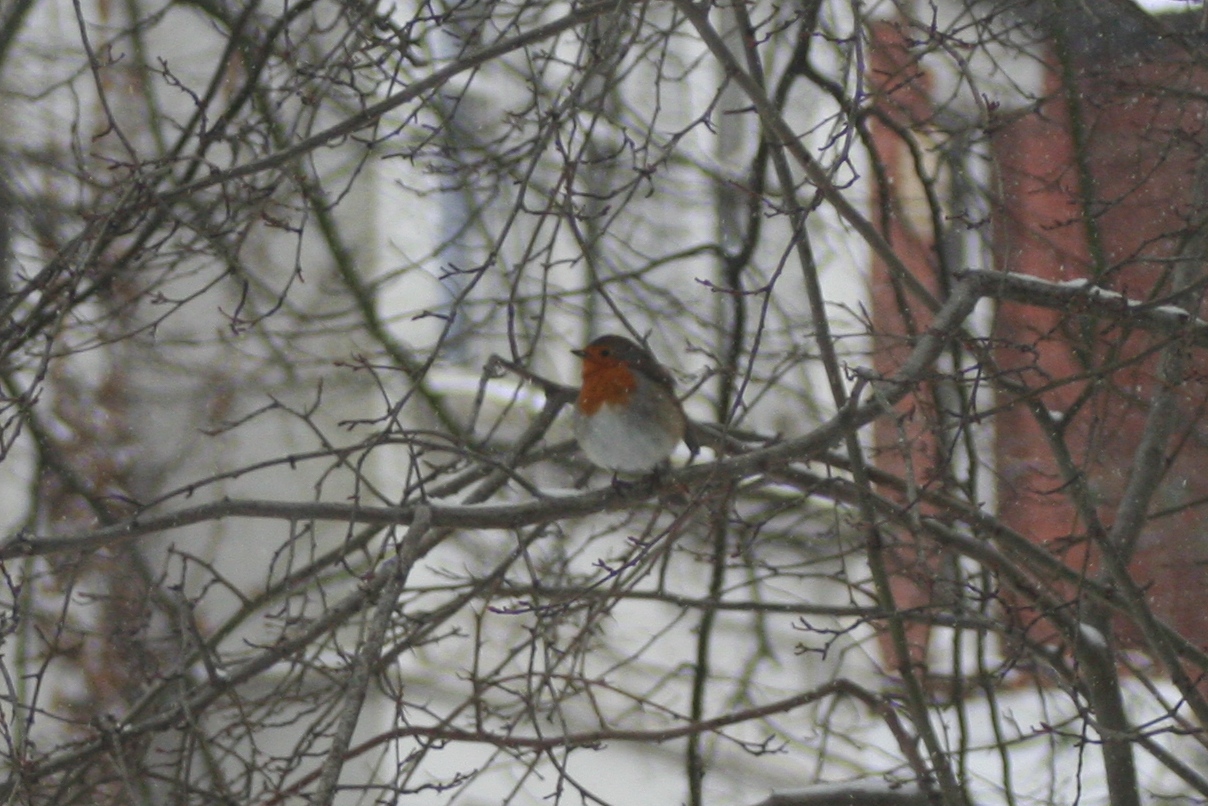
But I have always preferred looking for smaller birds – you have to look harder but it’s definitely worth the effort. There were long-tailed tits high in the trees, and British birds don’t get much smaller than a wren that flew across my path. A robin perched himself on a branch long enough for me to get a decent photo. Further into the wood, I saw a great tit and a blue tit, both of which (like the wren) were too quick for my camera. A male blackbird doing a spot of foraging was not.


Then came the interesting part. Last time I went birdwatching in Cherry Tree Wood, back in December, I was lucky enough to see a goldcrest, a bird I also managed to spot in the City back in September. This time, I got to see not one but two of these wonderful little birds, looking for something to eat on the trunk of a large tree. A good start to my birdwatching year, I think!

19.1.13

Salt and pepper squid


When we order Chinese, one of my favourite dishes is the salt and pepper squid. This is usually deep-fried, but can you make a version that is both healthier and does not have the potential to start a fire? More to the point, could I?

Well, a Rick Stein recipe on the BBC Food website looked fairly straightforward. I rather like Rick Stein– when he did his Christmas special last month he admitted at the start that he was filming it at the height of summer, and his fish and chip shop in Padstow serves the joint-best fish and chips I have ever tasted (the other one can be found in Hastings; with all due respect to Poseidon in East Finchley, fish and chips always taste better when you can smell the sea). So I trusted his salt and pepper squid recipe. Which had the virtue of having not many ingredients; less is more!

I acquired the squid from our wonderful local fishmonger on the High Road. The guy even cleaned it for me, which was just as well as I’d’ve had no idea how to go about that.

The recipe called for two types of pepper – regular black pepper and sichuan/szechwan pepper; luckily we have both in our flat! The peppercorns had to be dry-fried and crushed with a mortar and pestle (which one is which?) before the salt was added.

Each squid ‘pouch’ had to be opened out flat and scored, with any remaining entrail-like bits being scraped off before I cut it into squares. 

Frying the squid in a small amount of oil rather than half a pan of the stuff was quick, and it was a matter of minutes before the salt-and-pepper mixture was added. Then it was just a question of throwing in the spring onions and the chilli, stirring everything together and serving.

Quick, easy and delicious, even if I do say so myself!